The no contact rule: why it breaks
No contact is the single most effective step after narcissistic abuse, and the hardest to hold. Here is what it does, how to do it, and why people relapse.

No contact means closing every channel: phone, email, social accounts, and messages relayed through other people.
It is the most consistently recommended step after leaving an abusive relationship, and the one people fail at most often. Both of those facts have the same cause.
That cause has a name and a body of research behind it. Dutton and Painter’s test of traumatic bonding theory found the strongest attachments form where abuse arrives intermittently, which is precisely the bond that contact keeps alive.
It is not a strategy to make someone miss you. It is not a punishment, and it is not a test. It is the condition under which a conditioned nervous system finally gets enough quiet to recalibrate.
How does the no contact rule work?
The trauma bond does not end when the relationship does. It runs on cycles of harm and relief, and it stays live as long as it keeps getting input.
Every notification, every profile check, every update from a mutual friend is input. Each one tells your nervous system that the situation is ongoing and reconciliation is still possible.
No contact is not primarily about them. It is about removing the thing that keeps resetting your recovery clock.
Which is why partial no contact tends not to work. Blocking their number but watching their stories is not no contact. It is contact with extra steps and none of the benefit.
Should you use no contact or low contact?
Full no contact is not always available, and pretending otherwise makes people feel like failures for a situation they did not choose.
| Situation | What to do |
|---|---|
| No children, no legal ties | Full no contact. Block every channel. |
| Shared children | Low contact: written only, logistics only, monitored platform. |
| Legal proceedings ongoing | Contact through legal representation only. |
| Shared workplace | Minimum professional contact. Involve HR early. |
| Family member | Structured low contact, plus a plan for family events. |
Where you are forced into low contact, the grey rock method is how you run that channel without feeding it.
Low contact is not a diluted no contact. It is a narrow channel with the emotional content stripped out: factual, written, about logistics, and delayed rather than immediate.
The delay is the part people skip and it does more work than anything else. Immediate replies signal availability. A reply that comes in six hours, in one sentence, signals a channel rather than a relationship.

How do you start no contact?
Do this in one sitting, not gradually. A slow taper leaves gaps, and gaps are where the relapse happens.
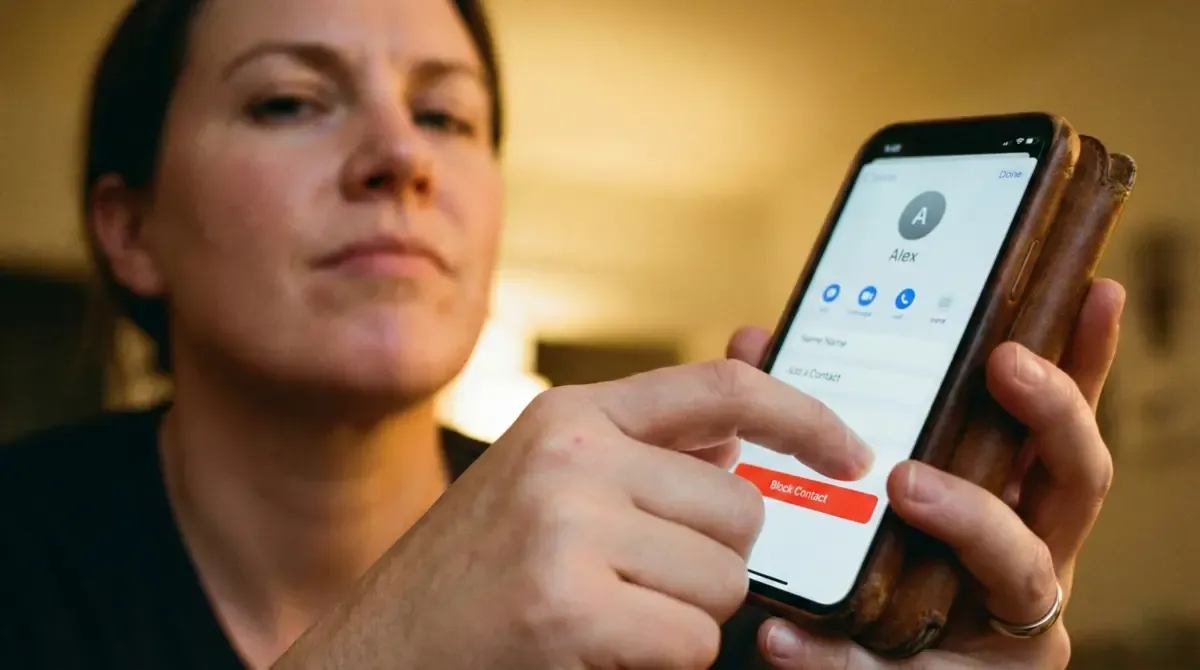
- Block on every platform, including the ones you think are dormant. Phone, email, all social accounts, payment apps, shared streaming, anywhere a message can arrive.
- Tell your two or three people what you are doing and ask them not to pass on news in either direction. Be explicit, because they will otherwise think they are helping.
- Decide your one line for anyone who approaches you on their behalf. “I am not discussing my relationship.” Say it once, do not elaborate.
- Remove the checking routes. Log out, delete the app for a while, unfollow mutuals whose feeds carry them. You are not being dramatic. You are removing a compulsion’s supply.
- Write the reason down. Not a list of their crimes, a list of how you actually felt. At 2am you will not have access to that, and past-you will need to speak to present-you.
- Plan the first weekend. The unstructured hours are the risk, not the working days.
Why is no contact so hard to keep?
It breaks in predictable ways, and knowing them in advance is most of the defence.
Withdrawal gets mistaken for a message. Days three to ten are usually the physical worst: agitation, obsessive thoughts, disrupted sleep, a genuine ache. It feels like proof that you have made a mistake. It is the same shape as any withdrawal, and it passes.
The good memories come back first. Recovery does not begin with clarity. Early on the mind supplies the highlights, not the harm, which is exactly when contact feels most reasonable.
Hoovering arrives at the right moment. Sudden warmth, an apology that concedes nothing specific, a crisis that needs you, a message on a significant date. It rarely arrives when you are strong. It tends to arrive when you are not, because timing is part of the technique.
Someone reasonable talks you out of it. A friend or family member who does not understand coercive control will suggest that blocking is extreme, or that people deserve a chance to explain. They mean well and they are wrong.
One small exception. A reply about a shared item. A civil answer to a civil message. The exception is never the problem. The problem is that the channel is now open again, and both of you know it.
Each contact is a small reward that resets the conditioning. Intermittent reinforcement explains why.
What happens in the first month of no contact?
Week one is adrenaline and vigilance. You will check whether the block worked more than once.
Week two is when the withdrawal usually peaks, and when most people break. If you know that in advance, it is survivable as a phase rather than interpreted as a sign.
Weeks three and four bring the first genuinely flat days, and those feel worse than the crisis, because there is nothing to react to. That flatness is not depression setting in. It is what an unstimulated nervous system feels like after a long period of intensity, and it is the beginning of the recalibration.
Somewhere in there the intrusive replaying loosens, usually without you noticing on the day it happens.
If they turn up anyway
Do not respond, do not read it twice, and do not screenshot it to a friend for interpretation. Interpretation is engagement.
If there is a legitimate logistical matter, answer that matter only, in one line, after a delay, in writing.
This is also where firm boundaries stop being abstract.
If contact escalates into anything that frightens you, treat it as a safety issue rather than a relationship issue. Save messages, keep dates, and tell someone.
Escalation after a boundary is a known pattern, not an anomaly, and the stakes are not theoretical. A Lancet systematic review across 66 countries found that more than a third of women who are murdered are killed by an intimate partner.
It concluded that such violence commonly represents the culmination of a long history of abuse.
If any part of this frightens you, treat it as a safety matter and involve crisis support rather than handling it alone.
If the person you are going no contact with is a parent or sibling, Family estrangement covers the particular grief and pressure that come with it.
Common questions
How long does no contact need to last? It is not a period you serve. Where there are no shared obligations, the honest answer is permanently. The bond does not expire, and contact reactivates it years later.
Is it cruel not to explain? No. You are not obliged to supply an explanation that will be used to negotiate. A relationship you are ending under these conditions does not owe a closing statement.
What if I broke it? It is not a streak. Reopen the channel closure and start from where you are. Most people break it at least once, and treating that as total failure is what turns a slip into a return.
Why does it feel like withdrawal? Because it is one. The trauma bond runs on cycles of harm and relief, and no contact removes both at once.
Does no contact make them come back? Often, yes, and that is not the aim. If you are doing it hoping for that, you are still in contact with them mentally, which is the part that matters.
What if we share children? Then full no contact is not realistic and low contact is the goal: written, logistics only, delayed, on a monitored platform where possible.
What it is really for
The silence is not the point. The silence is what makes the rest possible.
You cannot regulate a nervous system that is still being pinged. You cannot grieve something that keeps returning. You cannot rebuild a self while the person who edited it still has editing rights.
No contact buys the quiet. What you do in the quiet is the actual recovery.
For what often happens on their side once contact stops, read narcissistic collapse.
For the mechanism you are working against, read trauma bonding. If you need the practical exit first, start with how to leave a narcissist.
For structured support, the 8 week recovery program is built around this stage.
Coaching is not therapy and is not a substitute for medical or psychiatric care. If you are in crisis, please use the support resources on this site or contact your local emergency services.