Narcissistic devaluation: when warmth turns
Devaluation is the phase where the person who adored you starts dismantling you. Here is how it works, why it is so disorienting, and what recovery needs.

Devaluation is the phase where the person who could not get enough of you starts finding you disappointing.
It rarely arrives as an event. It arrives as a slow change in temperature, one you notice long before you can name it.
It is also the phase that does most of the damage to your sense of yourself.
Not because it is dramatic. Because it is gradual enough that you adapt to each step.
What is narcissistic devaluation?
It is the systematic reduction of your standing in the relationship, from the person who was idealised to the person who is a problem to be managed.
The mechanism is comparison. You are no longer being measured against other people, which is how the idealising phase felt. You are being measured against the version of you from the beginning, and found wanting.
That is what makes it so effective. You end up trying to earn your way back to a version of yourself that only ever existed in their telling.
The research here is clarifying rather than abstract. A large study in the Journal of Personality and Social Psychology separated narcissism into two components with opposite effects.
Admiration is charming, and it makes beginnings intense. Rivalry is devaluing and contemptuous, and it degrades relationships over time.
Devaluation is rivalry becoming the dominant mode. It is not a response to something you did. It is the other half of a pattern that was always there.
Work on pathological narcissism in intimate relationships describes the same cycle from the partner’s side: idealisation, then devaluation, as a repeating structure rather than a sequence of separate incidents.
The narcissistic abuse cycle covers the whole loop, and how it maps onto the older cycle of abuse.
Why does devaluation feel like withdrawal?
Because chemically it resembles it.
The idealising phase ran on unpredictable, intense reward. Your brain marked this person as a powerful source of it. When the supply reduces, you do not respond by reassessing them. You respond by seeking.
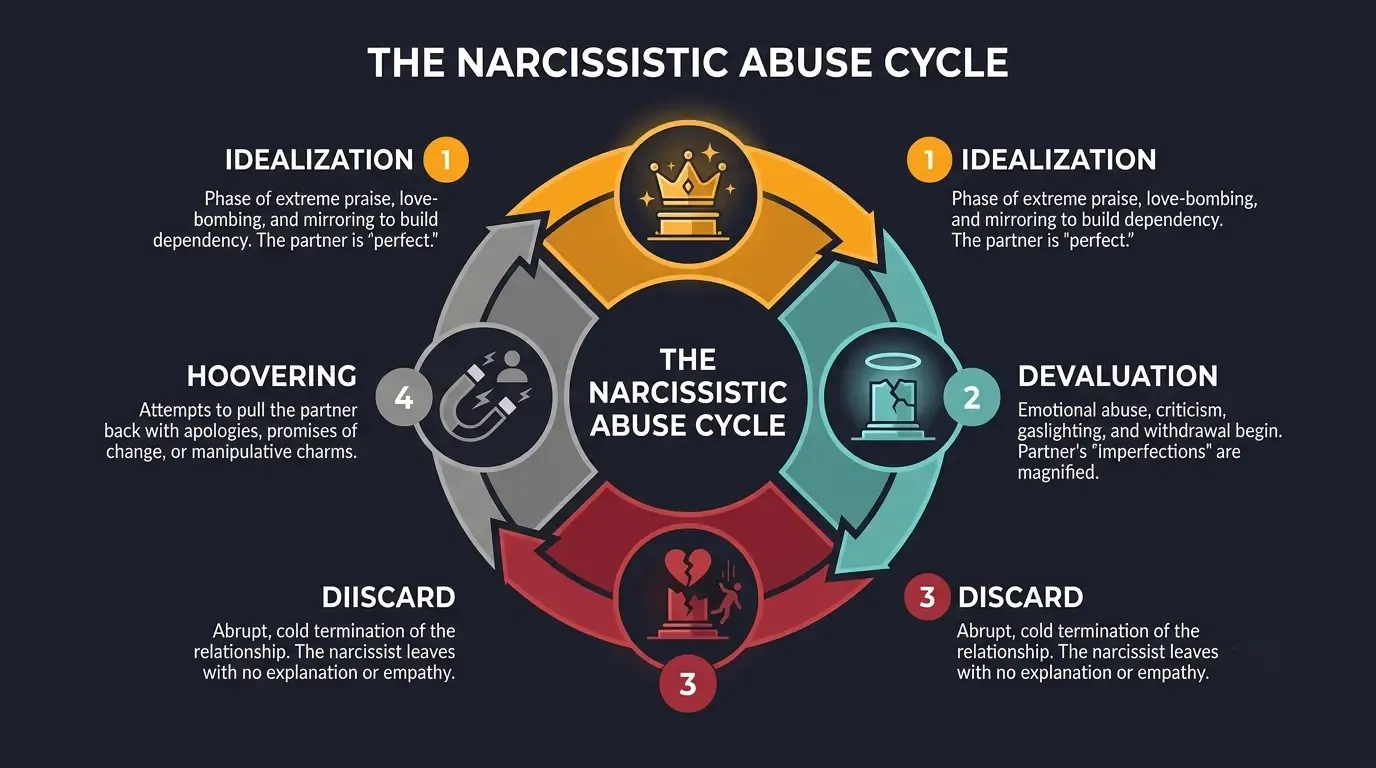
That is why devaluation makes people try harder rather than leave. The behaviour that would look irrational from outside is exactly what an intermittent reward schedule produces.
And the occasional return of warmth is not a break in the pattern. It is the part that keeps the pattern running.
What are the stages of narcissistic devaluation?
Early: the temperature drops. Slightly less interest. A joke with an edge. A withdrawal of attention you cannot quite point to. You start monitoring. You have not yet realised you are monitoring.
Middle: criticism becomes the medium. Corrections about how you speak, spend, dress, parent, work. Individually defensible, cumulatively a project. This is where people begin pre-editing themselves.
Late: contempt replaces criticism. Criticism implies you could improve. Contempt implies you are the problem. Eye-rolling, mimicry, indifference to distress they caused. This is the most corrosive stage and often the one people minimise most.
Covert devaluation. This is the signature of the covert narcissist. Not raised voices but sighs, concern used as a weapon, being undermined in private and praised in public. Harder to name, and much harder to get outside validation for, because nobody else sees it.
| Overt devaluation | Covert devaluation |
|---|---|
| Direct criticism and open anger | Concern used as a weapon, heavy sighs |
| Humiliation in front of others | Undermining in private only |
| Obvious hot and cold swings | Subtle withdrawal that creates confusion |
| Easy for you to identify | Outsiders see nothing wrong |
| A grandiose self-image | A victim self-image |
If your experience is the right-hand column, the isolation is worse. There is nothing quotable to show anyone.
Sex often changes on the same schedule, from a form of closeness to something withheld, demanded or scored. Where entitlement is driving that rather than distance, sexual narcissism is the measured version of it.
Much of devaluation is carried out in words. Verbal abuse covers what that does over time.
What it does to your internal model
This is the part that outlasts the relationship.
Sustained devaluation does not just make you unhappy. It edits your baseline assumptions about yourself.
What you are worth. How much space you can take. What you can expect from people. Whether your read on a situation can be trusted.

You stop bringing things up because bringing things up costs more than the thing. Then you stop noticing the things. Then you stop having the reactions that produced the things.
That progression is why people leave these relationships and say they do not know who they are. Devaluation did not only make you smaller inside the relationship. It rewrote the settings you take everywhere else.
One of devaluation’s main tools is moving the goalposts: a standard that changes every time you meet it.
Why you cannot think your way out
Because the conclusion and the conditioning live in different systems.
You can know, in full detail, that the criticism is not accurate, and still flinch when they clear their throat. You can be certain the relationship is harmful and still feel the pull toward repair.
Understanding is necessary and it is not sufficient. The part of you that learned to scan for mood is not reading your analysis.
This is the single most common place recovery stalls: someone becomes an expert on narcissistic abuse and remains exactly as dysregulated as they were.
How long does the devaluation phase last?
Longer than people expect, because devaluation is not usually a phase that ends. It is the operating state that idealisation was temporary relief from.
The cycle can run for years, and the intermittent returns to warmth are what make it survivable enough to continue.
It ends when the relationship does, or when contact is structured tightly enough that the cycle cannot run. Often it ends in a discard, which arrives suddenly even after months of this.
If you are still in it, setting boundaries is the first thing that changes the dynamic rather than your tolerance of it.
What recovery actually requires
Three things, and skipping any one of them is why people plateau.

Naming the pattern accurately. Not “we had problems” but a specific account of what happened, in order, without the softening you have been applying. Written down, ideally, because the softening is automatic.
Nervous-system work, not just insight. The flinch, the scanning, the pre-editing: those are physiological habits and they respond to physiological work. Somatic practice, breathwork, and deliberate regulation are how the body gets told it is over. A 2024 systematic review and meta-analysis of psychosocial interventions for survivors of intimate partner violence supports structured psychological support as genuinely effective here, which is worth knowing if you have been treating your own recovery as optional.
Rebuilding the parts that were edited out. The opinions, the preferences, the friendships, the way you used to take up space in a room. Not as nostalgia. As reconstruction.
Judith Herman’s Trauma and Recovery (1992) framed recovery from prolonged relational harm in a sequence that still holds: establish safety first, then process what happened, then reconnect. People generally try to do all three at once and wonder why nothing settles.
Common questions
Was the good phase fake? It happened, and your feelings in it were real. It was not a stable judgement of your worth, which is the part that hurts. Both are true.
Did I cause the devaluation? No. The research shows this pattern is a trait-driven cycle, not a response to a partner’s failings. Any explanation that puts the cause in you would have found something else if you had been different.
What was the criticism actually for? It keeps you working for a reaction you used to get freely. That is the supply dynamic seen from the inside.
Why do I still want their approval? Because you were conditioned by an intermittent reward schedule, and those are the hardest to extinguish. Wanting it is not a character flaw and it is not evidence you should go back.
Can devaluation happen without shouting? Yes, and the quiet version is often more damaging, because you get no external corroboration.
What to take from this
If you are in it, you are not too sensitive and you are not failing to keep up.
You are adapting, one small concession at a time, to a moving standard that was never meant to be met. The exhaustion is from the adapting, not from a deficiency in you.
If you are out of it, the work is not more analysis. It is the body, and the slow return of the parts you filed away.
For the phase this replaced, read love bombing. For the mechanism keeping you attached, read trauma bonding. For structured support with the rebuilding, the 8 week recovery program is built around it.
Coaching is not therapy and is not a substitute for medical or psychiatric care. If you are in crisis, please use the support resources on this site or contact your local emergency services.