The narcissistic discard: why it hurts
Being discarded by a narcissist does not feel like an ordinary breakup, and there are structural reasons for that. Here is what happened and how it heals.

A narcissistic discard is the abrupt withdrawal of a person who, until recently, behaved as though you were the centre of their world.
It does not feel like an ordinary breakup. People consistently describe it as bereavement mixed with confusion, and they are usually embarrassed by how badly it has hit them.
There is nothing to be embarrassed about. The discard is structurally different from a normal ending, and that difference explains the wreckage.
What is the narcissistic discard?
In an ordinary ending, closeness declines before the relationship does. There are arguments, distance, conversations. By the time it ends, both people have watched it end.
What often precedes a discard instead is breadcrumbing, a stretch of minimal contact that reads as a rough patch rather than an ending.
A discard removes the person while the attachment is still fully engaged. The exit is sudden, the explanation is absent or contemptuous, and the warmth you had months earlier is nowhere to be found.

Three things make it land harder than a breakup.
There is no coherent story. Ordinary endings come with reasons. A discard often comes with a version of events in which you were the problem all along, which is impossible to reconcile with how you were treated at the start.
The withdrawal is total. Not a fading, a switch. The same person who could not be apart from you can now be entirely indifferent, and that contrast is what people cannot process.
Your nervous system was already dependent on them. The cycle of harm and relief had made this person your regulator. Removing them does not just end a relationship, it removes the thing your body had been organising itself around.
Why does it happen?
Because the closeness was never built on what you thought it was built on.
This is where the research is genuinely clarifying. A large study in the Journal of Personality and Social Psychology separated narcissism into two components with different effects on relationships: admiration and rivalry.
Admiration is the charming, magnetic, self-promoting side. It is very effective at starting relationships. Rivalry is the defensive, devaluing, contemptuous side, and it is what degrades relationships over time.
That is the whole arc in one finding. The trait that made the beginning extraordinary is not the trait that governs the end. You did not imagine the early version. You met the admiration, and later you met the rivalry.
Later work on pathological narcissism in intimate relationships found the same broad shape. Partners consistently reported cycles of idealisation followed by devaluation.
A pattern, in other words, rather than a series of isolated incidents.
So a discard is rarely a considered decision about you. It is what happens when the useful phase ends.
Was any of it real?
This is the question that keeps people awake, and the honest answer is both.
The early phase was real in the sense that it happened, and the feelings you had in it were genuinely yours. It was not real in the sense you assumed, which was that it reflected a stable assessment of your worth.
Holding both is unbearable at first, and the mind keeps trying to collapse it into one answer. Either it was all fake, which makes you a fool, or it was all real, which makes the ending inexplicable.
Neither is true, and the discomfort of holding both is not a sign you are stuck. It is the actual work.
What the weeks after actually look like
Four things tend to happen, roughly in this order, though they overlap and repeat.
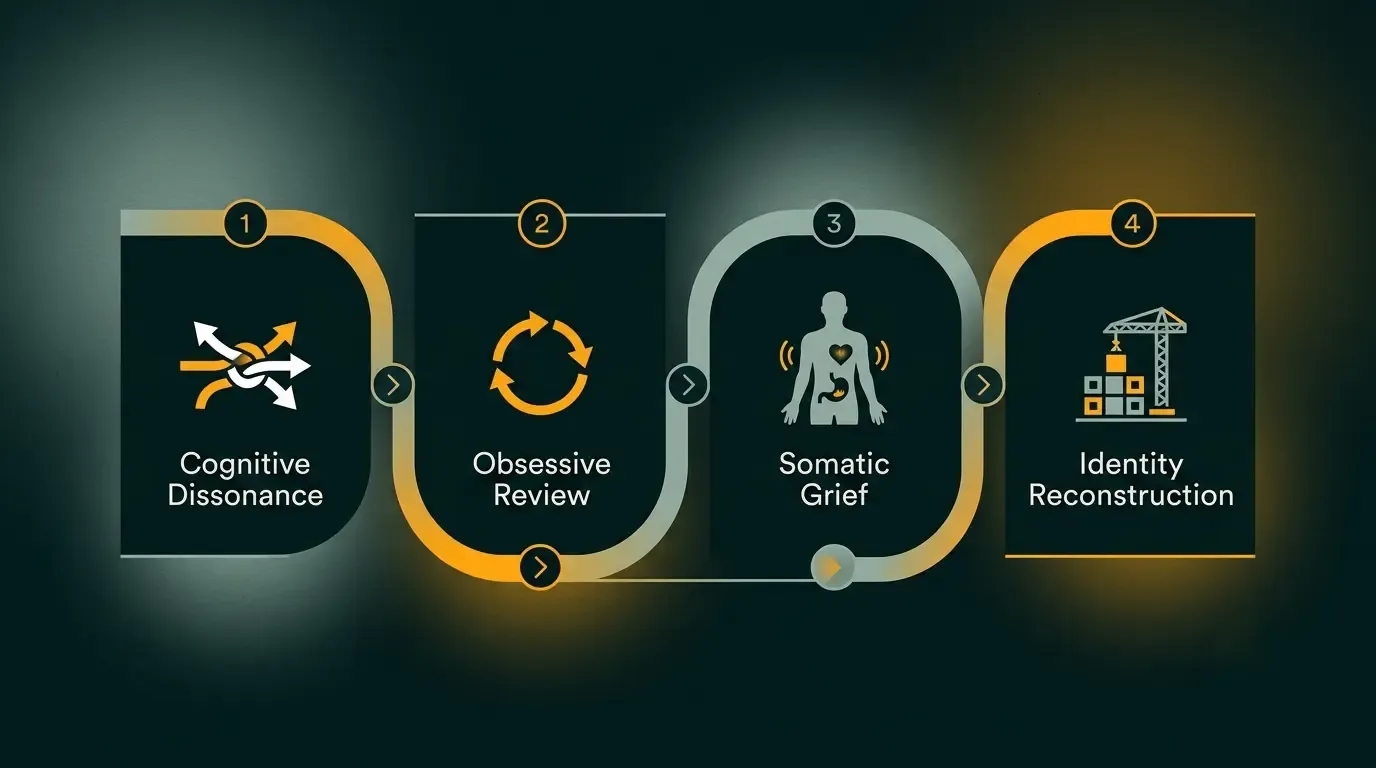
Cognitive dissonance. Two irreconcilable versions of the same person, running at once. Exhausting, and the main reason people cannot concentrate on anything else.
Obsessive review. Replaying conversations, hunting for the moment it turned. This is your mind trying to build the missing explanation. It feels productive. It mostly is not, because the information you are looking for was never available to you.
Grief in the body. Not only sadness. Disrupted sleep, appetite changes, a physical ache, adrenaline at odd hours. Your body is withdrawing from a person it had been regulating against.
Identity questions. Who am I without this. What do I actually like. Was I always like this. Uncomfortable, and also the beginning of the way out.
Not every discard works the same way
It helps to know which kind you are dealing with, because it changes what to expect next.
| Type | What it looks like | What usually follows |
|---|---|---|
| Punitive | Sudden, cold, often after you asserted something | High chance of contact attempts once the point is made |
| Replacement | They already had someone lined up | Quieter at first, contact often returns when that ends |
| Slow fade | Gradual withdrawal until you end it yourself | They keep the story that you left |
| Reactive | Follows you setting a boundary or seeing clearly | Frequently followed by an attempt to re-establish control |
If the coldness built gradually before the exit, that earlier phase has its own name and its own damage: narcissistic devaluation.
Notice that most rows end with the same thing. Which brings us to the part people are least prepared for.
Will they come back?
Often, yes, and it will not be because they reconsidered.
The return has a name in recovery circles: hoovering. It arrives as sudden warmth, or an apology that stops just short of accountability. Sometimes a crisis that requires you, a message on an anniversary, or a mutual friend mentioning they have been asking about you.
The function is the same in every version: re-open access. It is worth understanding what they are actually reaching for, because it is rarely you specifically.
The timing is usually not about you either. Contact tends to resume when whatever replaced you becomes less available, which is why it can arrive months after silence and feel uncannily well-timed.
Knowing this in advance changes the experience of it. A message you expected is a message you can decline. A message that ambushes you is one you answer at 2am.
How do you heal from a narcissistic discard?
Not by understanding it harder. Most people arrive at recovery having already read everything, and still feeling exactly as bad.

No contact, because the loop cannot quiet while access continues. Every reactivation resets the clock, and hoovering is designed to reactivate.
Grieve the actual loss. Not the person as they were at the end, but the future you had built in your head. That future was real to you, and losing it is a real bereavement even though nobody will treat it as one.
Work with the body, not only the story. This is where most recovery stalls. You can understand the mechanism completely and still have a nervous system that has not been told it is over. Somatic work, breathwork, and nervous-system regulation address what talking cannot reach.
Stop auditing yourself for the flaw that caused it. The obsessive review assumes there was a correct performance that would have kept the early version. There was not. The phase ended because the phase ends.
Rebuild the parts of you that got quiet. The opinions you stopped voicing, the people you saw less of, the things you liked before they became inconvenient.
Common questions
Why does the discard hurt more than the abuse did? Because during the relationship you still had access to the relief. The discard removes the harm and the relief at once, and the withdrawal from the relief is what floors people.
Did they ever love me? They were capable of intensity toward you, which is not the same as a stable regard for you. That distinction is painful, and it is also the one that eventually sets you free.
Should I ask for closure? Closure requires an honest account from someone with no incentive to give you one. Asking usually reopens the cycle. Closure here is something you build, not something you receive.
How long does this take? The acute phase is usually weeks rather than months, though it does not feel that way while you are in it. Rebuilding takes longer. Contact resets it, which is the strongest practical argument for no contact.
The part nobody says
Being discarded by someone who treated you badly is not a smaller loss because they treated you badly.
You are grieving a person, a future, and a version of yourself that existed inside that relationship. That is three losses, and most people are only counting one.
Be patient with the size of it.
The third loss is the one people find hardest to name. Who am I after narcissistic abuse covers it, and why the self you lost comes back through small choices rather than big insights.
The narcissistic abuse cycle covers what usually follows a discard, and why the return is part of the pattern.
If you want structured support through this stage, the 8 week recovery program works through exactly this. For the mechanism underneath the pull you are feeling, start with trauma bonding.
Coaching is not therapy and is not a substitute for medical or psychiatric care. If you are in crisis, please use the support resources on this site or contact your local emergency services.