Spiritual Abuse: Signs, Examples and Healing
Spiritual abuse is control dressed up as faith, by a leader, a group or a partner. The signs, real examples, spiritual narcissism, and how to heal.
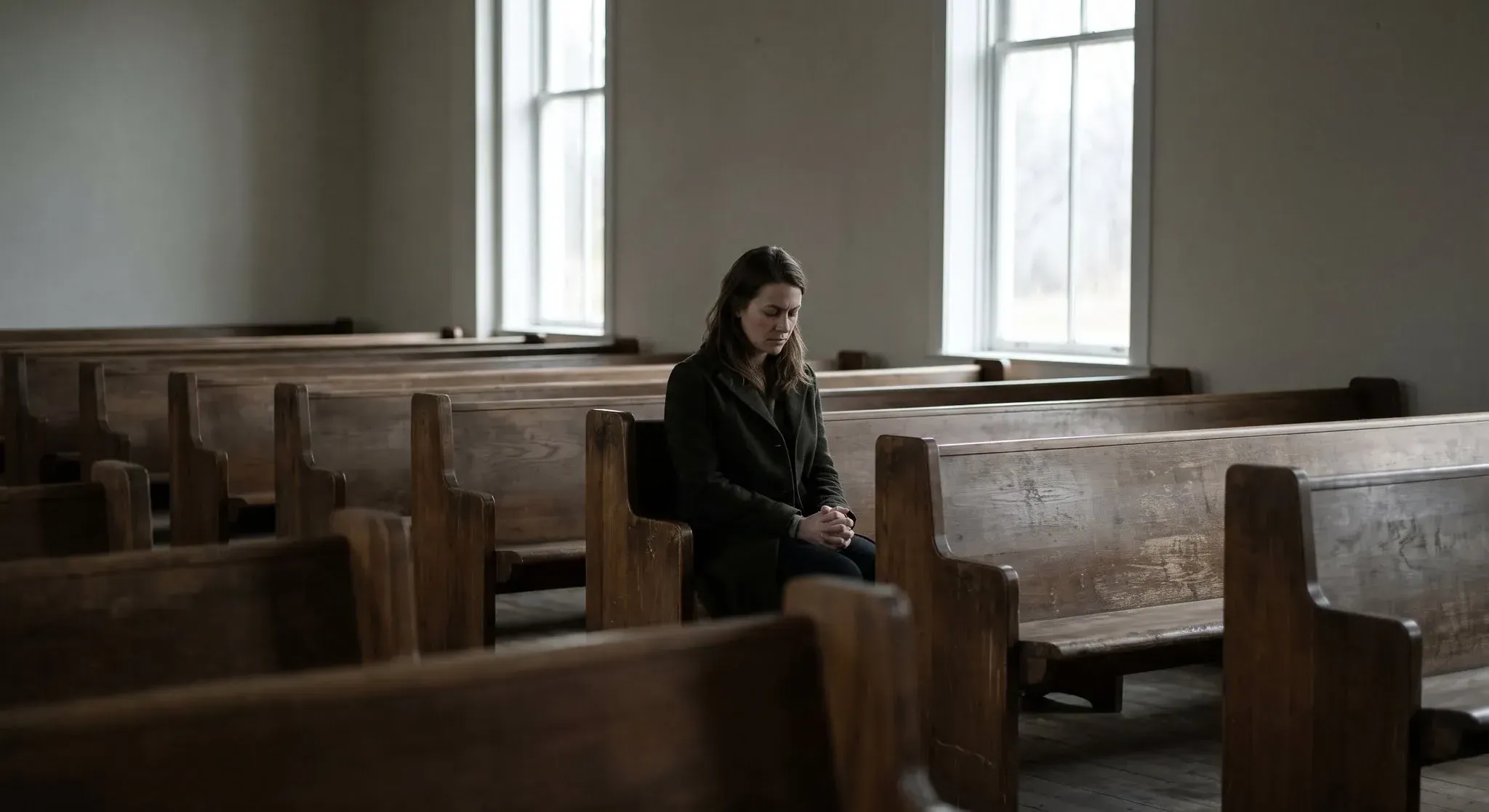
You were told that questioning the leader was questioning God. That your doubts were a sign of weakness, or sin, or not enough faith. That leaving would cost you your community, your family, maybe your soul.
Or it was not a church at all. It was your partner, quoting scripture to explain why you had to obey, forgive, stay.
Faith can be one of the most meaningful parts of a life. That is exactly why it can be used as a weapon.
What is spiritual abuse?
Spiritual abuse is the use of faith, religious authority or spiritual belief to control, manipulate, shame or isolate someone. It can come from a religious leader, a group or a partner.
It is a form of coercive control. The faith is not the problem. The abuse of it is.
It is also called religious abuse, and the two terms are used almost interchangeably.
This page respects faith. Many people who were spiritually abused keep their beliefs, and many find them again. Others leave. Both are valid. What matters is that the choice becomes yours.
Where does spiritual abuse happen?
In three main places, and they often overlap.
- In a religious group: a church, mosque, temple, community or movement where leaders use spiritual authority to control members.
- In a relationship: a partner who uses religion to justify control, demand submission or prevent you from leaving.
- In a family: parents who use God, sin or punishment to enforce obedience or shame a child.
It can also happen in spiritual and wellness communities, around teachers or gurus, where “growth” and “awakening” become the language of control.
What are the signs of spiritual abuse?
- Questions are treated as rebellion: doubt is framed as a spiritual failure, not an honest question.
- The leader cannot be challenged: they speak for God, and disagreement with them is disagreement with God.
- Fear is the main motivator: of punishment, damnation, demons or losing God’s favour.
- Shame is used to control: your worth depends on your obedience, purity or performance.
- Secrecy is required: problems must be kept “in the family” or “under the authority.”
- You are cut off from outsiders: people who left, or who do not believe, are dangerous or “of the world.”
- Your time, money or labour are demanded: giving is expected without limit or transparency.
- Leaving has a high price: you are told you will lose your community, your family or your salvation.
- Abuse is excused with scripture: suffering is “God’s will,” and forgiveness means staying silent.
What does spiritual abuse look like in a relationship?
Spiritual abuse in a relationship is a form of coercive control. The partner uses faith to justify control that would otherwise be obvious.

A 2009 study of abused women in an ultra-Orthodox Jewish community described spiritual abuse as a separate dimension of domestic abuse, alongside physical, psychological, sexual and financial abuse.
The researchers described three levels of it:
- Belittling your spiritual worth: mocking your faith, your prayers or your relationship with God.
- Preventing your spiritual practice: stopping you from attending services, praying or observing your faith.
- Forcing you to break your beliefs: pressuring you into acts that violate your spiritual commitments.
That was a small study of eight women, and the examples came from one community. The pattern it describes appears across many faiths.
Other forms are common too:
- “The Bible says you must submit.”
- “Divorce is a sin, so you cannot leave.”
- “God told me you belong to me.”
- “You are not being a good Christian wife if you say no.”
None of these are about faith. They are about control, using faith as cover.
What are some examples of spiritual abuse?
- A pastor who tells a woman reporting abuse to “pray harder” and return to her husband.
- A group that shuns members who ask about finances, and calls them “divisive.”
- A parent who tells a child that God is angry with them for crying.
- A spiritual teacher who demands sexual access and calls it “energy work” or “a test.”
- A partner who says you will go to hell if you leave.
- A community that publicly confesses people’s “sins” as a form of discipline.
What is spiritual narcissism?
Spiritual narcissism is a popular term, not a clinical one. It describes someone who uses spirituality to feel superior, gain admiration or control others.
It can look like a leader who presents themselves as uniquely holy, enlightened or chosen. It can also look like a partner who frames every conflict as your spiritual failing and their spiritual maturity.
The underlying pattern is the same as other forms of narcissism: a need for admiration and special status, and little regard for the people used to get it. Signs of a narcissist covers the general pattern. Communal narcissism covers the version built on visible goodness and caring.
What does the research show?
Spiritual abuse is a young research field, and most of it is recent.
Lisa Oakley and Kathryn Kinmond are two of the main researchers on spiritual abuse in Christian settings. Their 2024 UK survey received responses from 1,591 people in Christian contexts. 1,002 said they had experienced spiritual abuse.
That is not a prevalence figure. People who had experienced it were more likely to take part. It does show the scale of people who recognise the experience once it has a name.
Researchers are also starting to measure the opposite. A 2026 study of more than 800 people, mainly in North American Christian communities, developed a scale for spiritual safety. That means being able to practise your faith without coercion or manipulation.
Lower spiritual safety was linked to more PTSD symptoms. That is a correlation, not proof of cause, and it fits what survivors describe.
What are the effects of spiritual abuse?
People who leave spiritually abusive settings often describe:
- Shame and fear: a lingering sense of being bad, punished or watched.
- Loss of community: often all at once, because a whole social world was tied to the group.
- Confusion about faith: not knowing what you believe once the fear is gone.
- Distrust of your own judgement: especially if you were taught that your thoughts were dangerous.
- Grief: for the community, the certainty, and sometimes the relationship with God that felt safe once.
The term religious trauma is often used for this experience. It is not a formal diagnosis, but the symptoms people describe can overlap with trauma and toxic shame.
If leaving also means losing family, ambiguous loss covers that kind of grief.
How do you heal from spiritual abuse?
- Name it: calling it spiritual abuse, not “my failure of faith,” is often the first relief.
- Separate faith from the abuser: what they did is not what your faith requires. You get to decide what you believe.
- Go slowly with spiritual decisions: you do not have to decide now whether to keep, change or leave your faith.
- Find people who understand: survivor groups for spiritual abuse can recognise what others may not.
- Look for faith-aware support: a therapist or coach who respects belief, and does not push you towards or away from it.
- Rebuild trust in your own judgement: self-doubt covers how being overruled for years erodes it, and how it comes back.
If you are in danger, especially from a partner using religion to justify control, crisis support lists where to get help right now.

Common questions
What are the symptoms of spiritual trauma? Common experiences include fear of punishment, intense shame, anxiety around religious settings, confusion about beliefs and grief for a lost community. These overlap with other trauma responses.
What is the difference between strict religion and spiritual abuse? A strict faith asks a lot of its members but respects their freedom to question and to leave. Spiritual abuse removes that freedom through fear, shame, secrecy or punishment.
Can spiritual abuse happen outside religion? Yes. It can happen in wellness communities, around spiritual teachers or gurus, and in relationships where one partner claims spiritual superiority.
What is spiritual bypassing? It is using spiritual ideas to avoid painful feelings or real problems, for example “just stay positive” in response to abuse. It is not abuse in itself, but abusers sometimes use it to silence complaints.
Can I keep my faith after spiritual abuse? Many people do, sometimes in a different community or a different form. Others leave. Healing does not require either. It requires that the decision is yours.
What to take from this
Spiritual abuse is control dressed up as faith. It can come from a leader, a group, a family or a partner, and it works by turning your deepest beliefs into a source of fear.
The research field is young, but it already shows how many people recognise the experience, and how lack of spiritual safety is linked to trauma symptoms.
What you believe is yours. Nobody who used it to control you gets to keep that power.
Where to go next. Coercive control covers the wider pattern spiritual abuse belongs to.
Gaslighting and guilt tripping cover two tactics spiritual abuse relies on, and emotional manipulation covers the full set.
If you want support rebuilding after spiritual abuse, narcissistic abuse recovery coaching works with this, and respects whatever you decide about faith.
Coaching is not therapy and is not a substitute for medical or psychiatric care. If you are in crisis, please use the support resources on this site or contact your local emergency services.