Anxious Attachment: Signs, Causes, Healing
Anxious attachment is a fear of losing closeness that keeps you on alert in love. The signs, causes, why it pairs with avoidant partners, and how it changes.
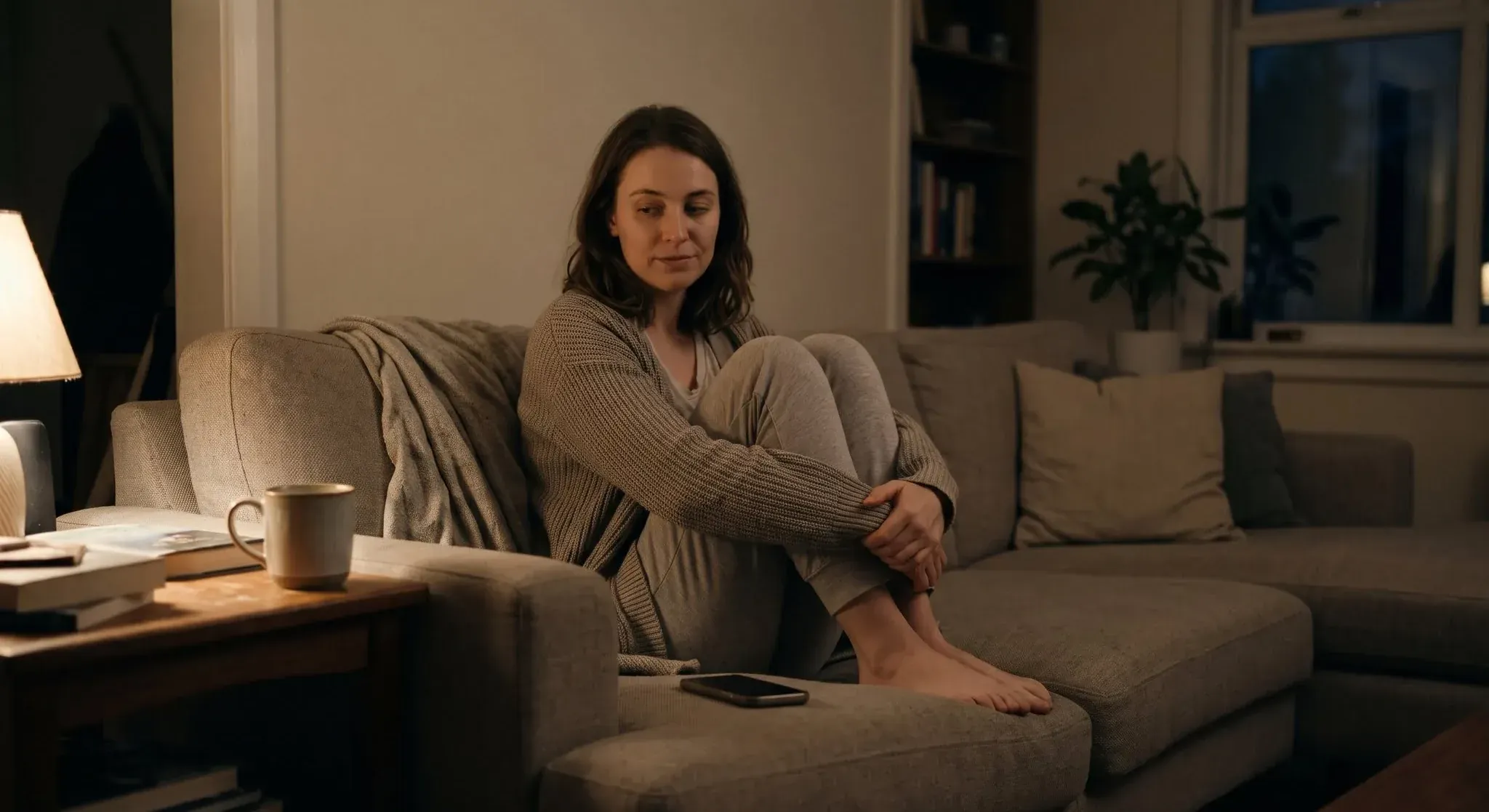
They take longer than usual to reply, and your stomach drops. By the time the message arrives you have already rehearsed the breakup.
You know it is out of proportion. Knowing does not stop it.
This is what anxious attachment feels like from the inside. It is not neediness. It is an alarm system tuned to the loss of closeness.
What is anxious attachment?
Anxious attachment is an insecure attachment style marked by a strong need for closeness and a persistent fear of losing it. Anxiously attached people monitor relationships closely, need frequent reassurance, and feel distance or silence as a threat.
It is not a diagnosis or a disorder. It is one end of a range that everyone sits somewhere on. Researchers call the underlying dimension attachment anxiety, and the popular label is “anxious attachment style” or “anxious preoccupied”.
The idea comes from attachment theory. A 1987 study by Cindy Hazan and Phillip Shaver was one of the first to apply it to adult love. They found the same three styles seen in infants (secure, avoidant and anxious) in how adults experienced romance.
What are the signs of anxious attachment?
- Reading into small changes: A shorter text, a flat tone or a cancelled plan feels like evidence that something is wrong.
- Needing reassurance: You ask “are we okay?” and the relief does not last long.
- Protest behaviour: When you feel distance you may text repeatedly, pick a fight or threaten to leave, to get a reaction.
- Fear of being too much: You hide needs, then they spill out all at once.
- Losing yourself: Your plans, moods and sense of worth start to depend on the relationship.
- Struggling with space: A partner’s need for time alone feels like rejection.
- Staying too long: Leaving feels more dangerous than staying in something that hurts.
What causes anxious attachment?
The classic account is inconsistent care in childhood. A parent who was warm sometimes and distracted, cold or overwhelmed at other times teaches a child that closeness is real but unreliable. The child learns to watch closely and protest loudly, because that sometimes brings the parent back.
Childhood is not the whole story. Attachment is shaped by later relationships too, and a painful adult relationship can make a secure person anxious.
A relationship that runs hot and cold can teach anxious attachment from scratch. That is what intermittent reinforcement does.
Is anxious attachment the same as fear of abandonment?
They overlap, and they are not quite the same thing. Fear of abandonment is the feeling. Anxious attachment is the wider pattern the feeling sits inside: how you seek closeness, read signals and react to distance.
Fear of abandonment covers the fear itself, where it comes from and how it eases.
Why are anxious and avoidant people drawn to each other?
Because each one confirms the other’s expectations. The anxious partner reaches for closeness. The avoidant partner pulls back. The pulling back makes the anxious partner reach harder, and the reaching makes the avoidant partner pull back further.

There is research on this pairing. A 1994 study of 354 dating couples found that attachment styles did not pair at random.
There were no anxious-anxious couples and no avoidant-avoidant couples. The relationships of anxious women and avoidant men were surprisingly stable over three years. Both partners had rated them poorly at the start.
That last detail is the important one. Unhappy is not the same as short. The pattern can feel bad and still hold you for years.
Why does anxious attachment attract narcissists?
Not every avoidant partner is a narcissist, and anxious attachment does not make you a target. But the overlap with narcissistic relationships is real.
A narcissistic partner often starts with intense attention. Love bombing feels like the reassurance an anxious system has always wanted. Then the warmth becomes unpredictable, and the anxious system does what it was built to do: it works harder to get it back.
That effort is easy to exploit. Breadcrumbing and the silent treatment both work by turning closeness on and off. The fear does the rest.
What does the research show?
The costs are measurable. A 2022 meta-analysis of 224 studies with nearly 80,000 people found that attachment anxiety was more strongly linked to poor mental health than attachment avoidance was.
There is also a link with violence in relationships, in both directions. A 2025 meta-analysis of 63 studies found that insecure attachment was tied to both using and experiencing partner violence.
For anxious attachment, jealousy, distrust and the need for control helped explain the link. Most of those effects were small. Insecure attachment explains some risk. It does not make anyone violent or a victim.
Is anxious attachment a form of BPD?
No. Anxious attachment is a relationship style that many healthy people have. Borderline personality disorder is a clinical condition with a much wider set of symptoms, diagnosed by a professional.
Fear of abandonment appears in both, which is where the confusion comes from. Having one does not mean you have the other.
Can anxious attachment change?
Yes. This is the most hopeful part of the research.
A meta-analysis of 127 papers followed attachment over time, from infancy to early adulthood. It found only moderate stability, and none at all across intervals longer than 15 years. Attachment is a pattern that moves, not a sentence.
Therapy can move it too. A systematic review of attachment change during therapy found that attachment security rose and attachment anxiety fell after treatment. The authors called for more controlled trials, so treat that as promising, not proven.
People who move from insecure to secure in adulthood are sometimes described as having earned secure attachment. It is earned through experience, mostly with people who stay.
How do you heal anxious attachment?

- Notice the alarm before you act on it: “My attachment system is firing” is a different thought from “they are leaving me”.
- Wait before you protest: Give the urge to text again twenty minutes. Often the wave passes on its own.
- Ask directly: “I feel uneasy when plans change at the last minute. Can you give me a heads-up?” is easier to hear than a test.
- Choose consistency: Predictable partners feel less exciting to an anxious system at first. That calm is what security feels like.
- Build a life outside the relationship: Friends, work and interests spread the weight, so one person’s mood is not your whole weather.
- Settle the body: The alarm lives in the nervous system as much as in thought. Nervous system regulation covers what helps.
If the anxiety is severe or tied to past abuse, a therapist who works with attachment can help a great deal. Coaching works alongside therapy, not instead of it.
Common questions
What triggers an anxiously attached person? Signals of distance: slow replies, changed plans, a partner’s need for space, or a flat tone. The trigger is usually small. The reaction is sized for a much bigger threat.
Is anxious attachment more common in women? No. People of every gender can be anxiously attached, and the signs are the same.
What is the best partner for someone with anxious attachment? A secure, consistent one. Over time, a consistent partner gives the anxious system the evidence it needs to calm down.
Can two anxiously attached people be together? Yes, though they may need to work harder to avoid feeding each other’s alarm. The 1994 study found none in its sample, which says more about attraction than about whether it can work.
Is anxious attachment my fault? No. It was learned, usually before you had any say. What you do with it now is the part you can change.
What to take from this
Anxious attachment is an alarm system tuned to the loss of closeness. It was learned in relationships, and it can be relearned in them.
The research is honest about the costs, and clear that attachment moves over a lifetime. What usually moves it is time spent with people who stay.
You do not have to stop wanting closeness. You only need to stop treating every silence as the end.
Where to go next. Trauma bonding covers why hot-and-cold relationships are so hard to leave.
Hypervigilance covers the scanning that anxious attachment shares with trauma, and how to trust again covers rebuilding safety after a relationship that broke it.
Hyper-independence covers the opposite reflex, which some people swing to after anxious relationships.
If you want structured support learning to feel safe in love, self-mastery coaching is built for exactly this kind of change.
Coaching is not therapy and is not a substitute for medical or psychiatric care. If you are in crisis, please use the support resources on this site or contact your local emergency services.