Narcissistic Husband: Signs and What to Do
The signs of a narcissistic husband show up in money, sex, children and conflict. What the research shows, why couples counselling can backfire, and what to do.
On this page
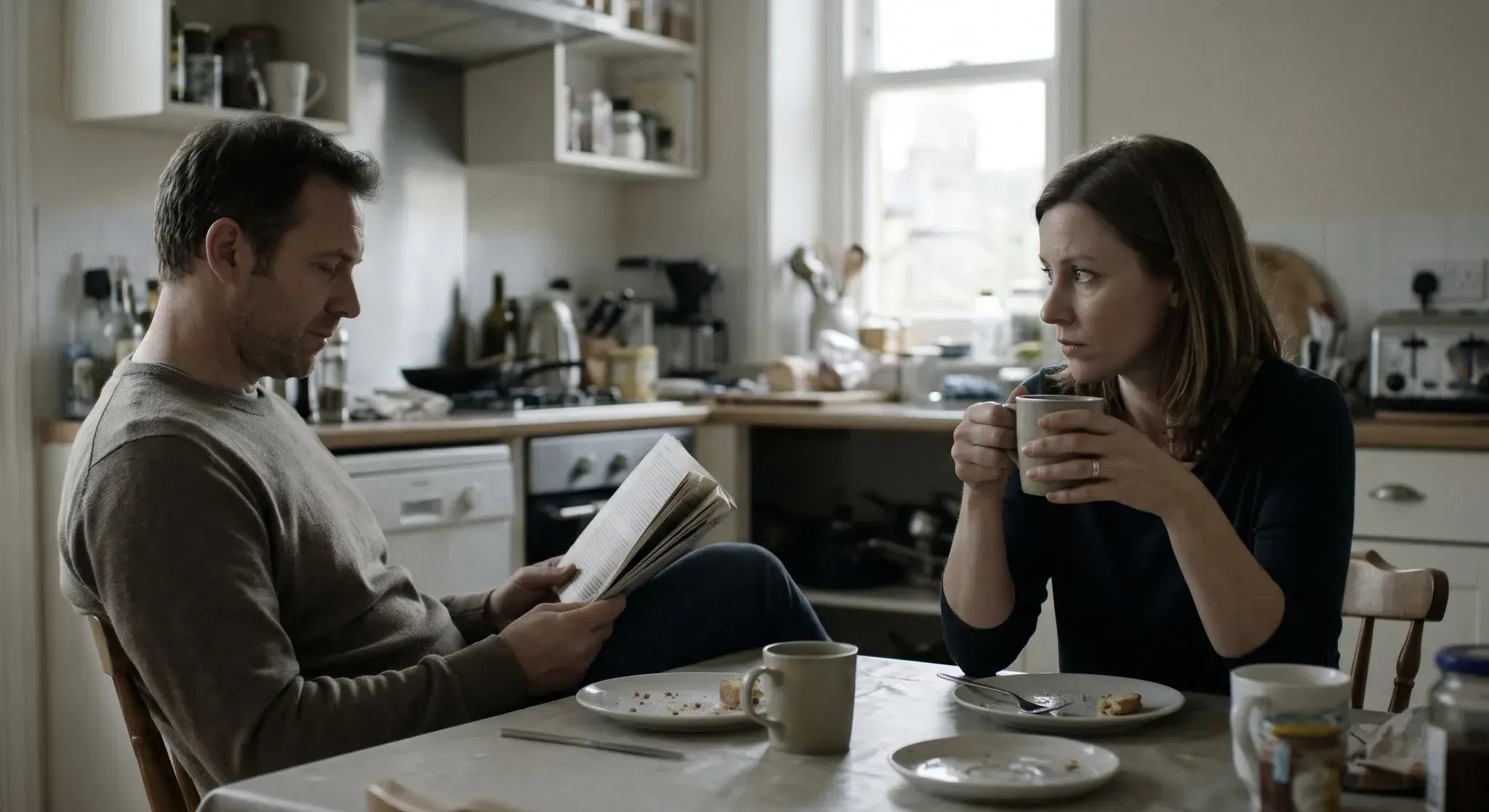
You married someone attentive, confident and sure of you. Somewhere along the way, the attention turned into monitoring, the confidence into contempt, and the certainty into a set of rules you keep breaking without knowing what they are.
And you are the one lying awake asking whether you are the problem.
This article is about that marriage. It covers how a narcissistic husband tends to show up day to day, what the research shows, and what you can do from where you are standing.
What is a narcissistic husband?
A narcissistic husband is a partner whose need for admiration, control and a superior self-image consistently outweighs your needs, feelings and reality. He may or may not meet the criteria for narcissistic personality disorder. What defines the marriage is the pattern: entitlement, low empathy, and punishment when you do not play your role.
Only a clinician who assesses him can diagnose a personality disorder. You do not need a diagnosis to recognise a pattern that is hurting you, and you do not need one to protect yourself.
If it is your wife, not your husband, narcissistic wife covers the same pattern from the other side.
What are the signs of a narcissistic husband?
The general signs of a narcissist apply. In a marriage they tend to collect around the things you share.
- Money is his, debt is yours: Spending is controlled, questioned or hidden. Your purchases need justifying. His do not.
- Sex is on his terms: Your yes is expected and your no is punished, through sulking, pressure or coldness.
- The children become an audience: He is a different man in front of them, or he recruits them into his version of you.
- Every argument ends with your apology: However it started, the conversation is rerouted until you are the one who did wrong.
- Your achievements shrink in his presence: Good news is ignored, corrected or turned into a story about him.
- He is admired outside the house: Friends, colleagues and family see the charming version. You get the other one.
- Your memory is the thing on trial: You start keeping notes because you no longer trust what you remember. Gaslighting explains why.
- Helplessness at home, competence at work: He can run a team but cannot load a dishwasher. That pattern has a name, weaponized incompetence.
One sign on a bad day proves nothing. Every marriage has selfish weeks. The pattern is the point: the same treatment, over years, that does not change when you say it hurts.
Why was he so different at the start?
Because the traits that make someone exciting to date are often not the ones that make him hard to live with. Research has separated the two.
A 2017 set of seven studies with 3,560 people split grandiose narcissism into two parts. Admiration is the drive to be seen as special, through charm and confidence. Rivalry is the drive to protect that image by putting others down.
Admiration explained the early romantic appeal. Rivalry explained the long-term problems in committed relationships.

So the man you fell for was the admiration side, and it was real. What you live with now is the rivalry side. It shows up when you stop being an audience and become a person with needs.
You did not misjudge him. You met these traits in the order they tend to appear.
What is it like to be married to a narcissist?
People who have lived it describe the same few things: confusion, walking on eggshells, and a slow loss of who they were.
A 2022 Australian study asked 436 people about relationships with someone high in narcissistic traits. Most were current or former romantic partners. Their accounts described physical, verbal, emotional and sexual abuse, along with difficult financial and sexual behaviour.
The partners reported high levels of anxiety, depression, illness and physical complaints. They also described being locked into cycles of idealisation and devaluation, alongside a dependency they could not easily break.
Maybe you recognise the exhaustion, the dread at the sound of his key in the door, the shoulders that never fully let go. You are not being dramatic. That is what a body does when it lives with someone unpredictable.
Is my husband a narcissist or just selfish?
The test is what happens when you name the hurt. A selfish husband who cares about you can hear “that hurt me” and adjust, even if he is clumsy about it. A narcissistic husband hears it as an attack and makes you pay for saying it.
Ask yourself three questions:
- Does he repair? After a fight, does he ever own his part without making you own more?
- Does your no cost you? When you decline, is there a punishment, silence, or a withdrawal of warmth?
- Is he the same man in private and in public? A large gap between the two is worth taking seriously.
If the answers worry you, but part of you wonders whether you are the difficult one, am I the narcissist? walks through that question honestly. People who ask it are rarely the problem.
What does a covert narcissistic husband look like?
A covert narcissistic husband is quieter. He is less likely to boast and more likely to sulk, sigh, feel misunderstood and cast himself as the victim of a demanding wife.
You may not see grandiosity at all. You see moods you are responsible for, a long memory for slights, and a sense that his needs always come first because his suffering is greater.
The covert narcissist article covers this presentation in depth. It is often missed for years because it looks like sensitivity.
Do narcissistic husbands cheat?
Not always, but the risk appears higher when narcissism shows up in the bedroom specifically. A study of 123 newly married couples found that a spouse’s sexual narcissism predicted infidelity over time. That held after accounting for marital and sexual satisfaction and for general narcissism.
The traits behind it were sexual entitlement, sexual exploitation, an inflated sense of sexual skill and, in husbands, a lack of sexual empathy. Sexual narcissism covers what that looks like and why it is a form of control.
Should we try couples counselling?
Be careful. Couples counselling assumes two people with roughly equal power who both want to change how they treat each other. In an abusive marriage, neither is true.
Many domestic abuse services advise against couples work while abuse is happening. The US National Domestic Violence Hotline does not encourage it, because abuse is not a relationship problem.
What you say in the room can be used against you on the drive home, and a skilled narcissist can charm the counsellor the way he charms everyone else.
Individual support for you is the safer place to start. A therapist who understands coercive control can help you see the marriage clearly. Coaching vs therapy explains which kind of help fits which need.
What should you do if your husband is a narcissist?
Start where you have control, which is you. You do not have to decide today whether to stay or go.

- Write things down: Dates, words, what happened. Keep it somewhere he cannot reach, such as a private email account.
- Stop explaining yourself: Long justifications give him more to dispute. Short answers protect your energy.
- Rebuild one outside connection: Isolation is how control works. One friend who hears the true version changes everything.
- Know your money: Find out what you own, what you owe and what is in your name. Financial abuse covers the warning signs.
- Hold one boundary at a time: Pick a small one you can keep. Boundaries with a narcissist covers how to hold it when he pushes back.
- Get support before you need it: A domestic abuse advocate can talk through options in confidence, whatever you decide.
If you share children, co-parenting with a narcissist covers what changes when they are part of the picture.
When is it time to leave?
Only you can decide that, and you are allowed to take time. But some signs mean safety has to come first.
A large US study of intimate partner homicide compared 220 women who were killed by a partner with 343 abused women who were not. Risk was higher where the abuser had access to a gun, had threatened with a weapon, or where the woman had separated from a controlling partner.
Keep that last finding in mind when you plan. Leaving a controlling man can be the most dangerous time, which is why leaving should be planned, not announced. How to leave a narcissist covers how to do it safely.
If he has threatened you, hurt you, or you are afraid of what he will do, please reach out today. Crisis support lists services you can contact now, including domestic abuse helplines.
Common questions
Can a narcissistic husband change? Some soften with age or sustained treatment they choose for themselves. It is rare, slow and not something you can produce. Can a narcissist change? covers the evidence.
How does a narcissistic husband treat his wife? As an extension of himself. You are praised when you reflect well on him and punished when you have needs of your own.
Are most narcissists men? More men than women score high on narcissism, but the gap is modest and women can be narcissistic too. Signs of a narcissist covers how it differs.
Why do I feel guilty when he is the one hurting me? Because guilt was part of the training. Years of being blamed teach you to look for your fault first.
Is there a test for whether my husband is a narcissist? No test can diagnose someone else. The narcissist test is a self-assessment, but reading its questions can help you put words to what you are seeing.
What to take from this
A narcissistic marriage is confusing by design. The charm was real, the cruelty is real, and they belong to the same man.
You do not need to prove what he is to anyone, including him. You need to see what the marriage is doing to you, and decide what you will do about it, at your own pace and with your safety first.
“Is he a narcissist?” can wait. The harder question is this one: who am I becoming in this marriage, and is that who I want to be?
Where to go next. Trauma bonding explains why it is so hard to leave someone who hurts you.
Narcissistic abuse cycle maps the loop of idealisation and devaluation you may be living in.
If you want support seeing your marriage clearly and planning your next step, narcissistic abuse recovery coaching starts with a free fit call.
Coaching is not therapy and is not a substitute for medical or psychiatric care. If you are in crisis, please use the support resources on this site or contact your local emergency services.