DARVO: how the reversal works
DARVO means deny, attack, reverse victim and offender. What experiments show it does to observers, why you end up disbelieved, and how to respond to it.

DARVO stands for Deny, Attack, Reverse Victim and Offender.
It describes what many people do when confronted about harm they caused. They deny it, then attack the credibility of the person raising it.
Then they swap the roles, so that they are the injured party and you are the aggressor.
Unlike most terms in this area, DARVO has a real research literature. It was named by the psychologist Jennifer Freyd, and her group has since tested it experimentally. What they found is the part worth reading.
What does DARVO stand for?
Three moves, usually in order, often inside a single conversation.
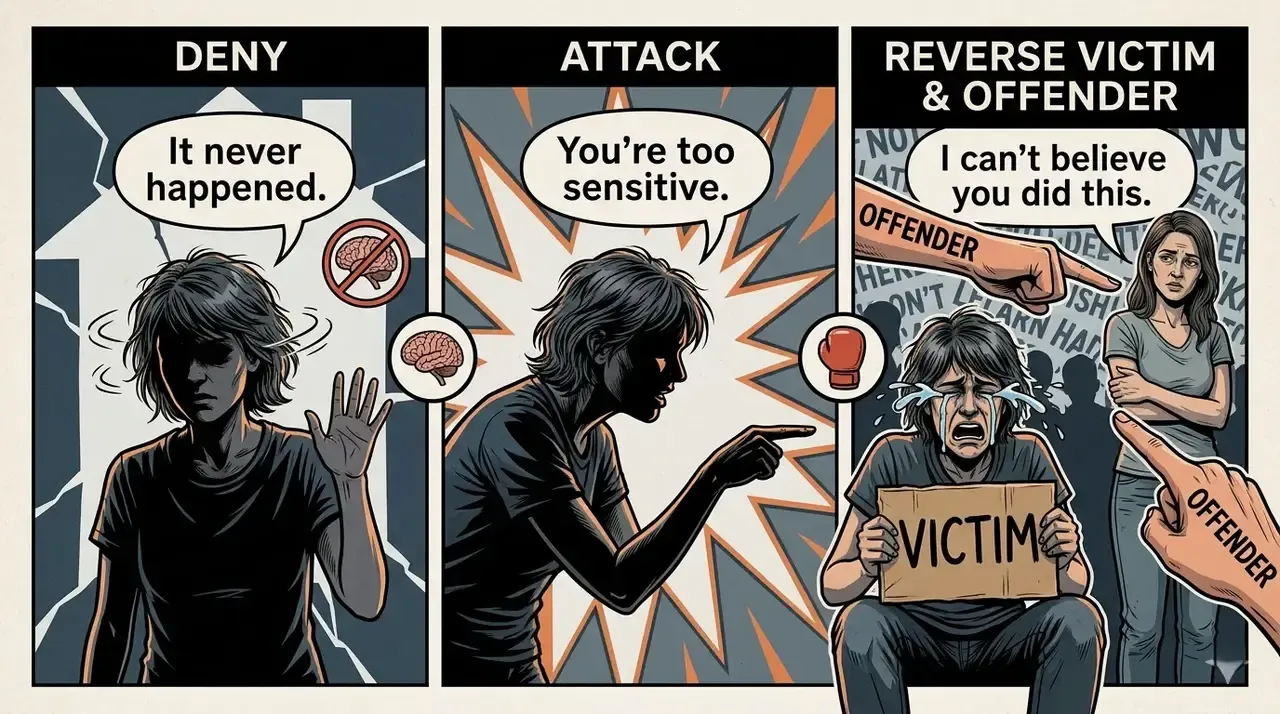
Deny. It did not happen, or not like that. Sometimes a flat denial, more often a small correction that reframes the whole event.
Attack. Not the claim, but you. Your memory, your stability, your motives, your history of overreacting.
Reverse Victim and Offender. The finishing move. They are hurt, you are cruel, and the conversation is now about their pain.
The sequence is what makes it recognisable. Denial on its own is just denial. It becomes DARVO when the denial turns into a counter-accusation and the original issue disappears.
What does DARVO sound like?
The phrases are recognisable once you have the pattern.
- Deny. “That never happened.” “You are remembering it wrong.” “I never said that.”
- Attack. “You are too sensitive.” “You always do this.” “You are the one with the problem.”
- Reverse. “I cannot believe you would accuse me of that.” “After everything I have done for you.” “You are the one hurting me right now.”
The tell is where the conversation ends up. You raised something, and within minutes you are apologising or defending yourself, and the original thing has not been discussed at all.
Does DARVO actually work?
Yes, and this is the finding that makes the term worth knowing rather than just naming.
A 2023 experiment published in the Journal of Interpersonal Violence tested it directly. Researchers wrote fictional scenarios in which a perpetrator either used DARVO or did not, and showed them to 230 participants.
The participants who saw DARVO rated the perpetrator as less abusive, less responsible, and more believable.
They also rated the victim as more abusive and less believable, and were less willing to punish the perpetrator while being more willing to punish the victim.
Insincere apologies, tested alongside, had minimal impact by comparison.
That is the whole problem in one result. DARVO is not just unpleasant to be on the receiving end of. It measurably moves what neutral observers believe, in the direction of the person who did the harm.
Two honest limits. The scenario was fictional and the participants were undergraduates, so this shows the tactic shifts judgements under test conditions rather than measuring what happens in any particular real dispute.
Why does it make you doubt yourself?
Because you came in with a complaint and left having been convicted of something.
The reversal does not just deflect. It gives you a new problem to solve, which is defending your own character. Most people take that on, because it feels urgent and because the alternative is being thought cruel.
Meanwhile the original issue has quietly gone. Not resolved, not denied successfully, just displaced by a more pressing argument.
Do it enough times and you stop raising things at all. That is usually the point, and it is why the behaviour persists.
What DARVO exposure does to you
There is now evidence on this, and it speaks directly to people in emotionally abusive relationships rather than only to the contexts DARVO was first studied in.
A 2026 study in the Journal of Trauma and Dissociation developed a short-form DARVO questionnaire and tested it across two samples, 319 people recruited online and 261 university students.
Two findings matter here.
DARVO exposure predicted trauma symptoms even after controlling for trauma history. So the association is not simply explained by people who have been through more also encountering more.
Exposure was higher in confrontations about emotional and psychological mistreatment than in other kinds. If that is the conversation you keep having, this is the tactic you are most likely to meet.
The researchers also found no association between DARVO exposure and gender or marginalised identity, which was contrary to what they expected. It appears to be broadly distributed rather than aimed at particular groups.
Is DARVO the same as gaslighting?
They overlap and they are not the same thing.
| Gaslighting | DARVO | |
|---|---|---|
| Target | Your grip on reality | Your position in the story |
| The claim | “That never happened” | “You are the one doing this to me” |
| Timing | Ongoing, over months | Usually in response to confrontation |
| What you lose | Trust in your own memory | Standing to complain at all |
| Audience | Usually just you | Often others as well |
Denial is the shared step. Gaslighting stops there and keeps going, wearing down your confidence in what you perceived. DARVO adds the attack and the role swap, and it is triggered by being confronted.
In practice the same person often does both, and a smear campaign is what DARVO looks like when it is run to an audience rather than to you.
Emotional manipulation covers how DARVO, gaslighting and the other tactics work together.
DARVO at work and in institutions
The same pattern appears when complaints are made to organisations, and the mechanics are more consequential there because the audience has formal power.

It looks like a grievance that becomes an investigation into your own conduct, or a performance concern appearing shortly after you raise something.
It also looks like a mediation where you are asked to consider the impact of your accusation on the other person.
Given the experimental finding, this is predictable rather than unlucky. If observers shift toward the person using DARVO, then a panel of observers will too.
What helps is unglamorous. Put the complaint in writing before any meeting, keep it factual and specific, and do not respond to character material with character material. Get advice early, and keep your own copies outside their systems.
How do you respond to DARVO?
You cannot win the reversal by arguing it, because arguing is the thing it needs from you.

Name the move, once, without heat. “We were talking about X.” Then return to X. Repeating that calmly is more effective than any rebuttal.
Do not defend your character. The accusation about you is the diversion. Answering it concedes the ground.
Keep one point. DARVO thrives on a widening argument. A single specific thing, restated, is much harder to reverse than a list.
Put it in writing. Written exchanges are far harder to reverse than spoken ones, because the record does not move.
Expect not to get agreement. The realistic aim is stating the thing clearly and holding your own account of it, not extracting an admission.
Leave the conversation when it turns. Once you are defending yourself, nothing further will be achieved that evening.
Write down what happened afterwards. Not for them. Because repeated reversals erode your own memory of who raised what, and a contemporaneous note restores it.
Where this is the normal shape of every disagreement, grey rock and firm boundaries matter more than better phrasing in the moment.
Why do they always end up as the victim?
DARVO is the version that happens during a confrontation. The same reversal also runs as a background setting, and it is worth separating the two.
Situational reversal is what this page has described so far. You raise something, and within a minute you are apologising.
Standing victimhood is broader. It is a permanent position from which everything is interpreted. Nothing is ever their responsibility, every relationship ended because of the other person, and every employer was unreasonable.
The second one is harder to see because it does not look like an attack. It looks like someone who has had extraordinarily bad luck with people.
The pattern that gives it away
Listen to how the stories are structured rather than to their content.
- They are never a participant. Things happen to them. Nobody in the account has a reason for what they did.
- The list is long and the theme is identical. Six exes, four bosses and two former friends, all unreasonable in the same way.
- Sympathy is requested, help is refused. Practical suggestions get declined, because a solved problem removes the position.
- Your own difficulties get absorbed. Mention something hard and it becomes a preamble to something harder that happened to them.
Why it works on decent people. Compassion is the correct response to distress, and you are not wrong to feel it. The reversal exploits exactly that instinct. The people most susceptible to it are the ones who take other people’s suffering seriously.
What to do with it. Stop supplying the sympathy the position requires, without becoming cold about genuine difficulty. The practical test is the same one that works everywhere else here. Does anything ever change, or does the account simply need retelling?
Common questions
Is DARVO always deliberate? Not necessarily. Some of it is practised defensiveness rather than strategy. The effect on you and on observers is the same either way.
Does DARVO mean the person is a narcissist? No. It is a response pattern, not a personality assessment, and people without any diagnosis use it. It appears often alongside narcissistic traits without being diagnostic of them.
How do I prove what happened? Usually you cannot, and building your plan around proving it tends to cost years. Contemporaneous written records are worth keeping regardless.
Why do other people believe them? Because the tactic works on observers, which is exactly what the 2023 experiment measured. It is not a failure of your friends’ judgement so much as a predictable result.
What if I did do something wrong? Both can be true. You can have handled something badly and still be on the receiving end of a reversal, and the second does not become fair because of the first.
Can you use DARVO accidentally? People do get defensive and overstate their hurt without planning it. The distinguishing feature is whether the original issue ever gets addressed once things settle.
What to take from this
If you have come away from conversations unable to work out how you became the accused, DARVO is very likely the name for it.
The useful part is not the label. It is knowing that the reversal has been tested and that it demonstrably shifts what onlookers believe. You are not failing to explain yourself well enough.
That changes the goal. It is not persuading the person doing the reversing, and not converting the audience either.
It is keeping hold of your own account of what happened, and putting it somewhere the argument cannot reach.
Where to go next. Reactive abuse covers the provocation that supplies the material for a reversal.
Smear campaign covers the same reversal aimed at a group, and flying monkeys covers the people who end up carrying it.
The grey rock method is the practical tool for conversations that always end this way.
If you want structured support, the 8 week narcissistic abuse recovery program is built for the aftermath. If there is any question of danger, start with crisis support.
Coaching is not therapy and is not a substitute for medical or psychiatric care. If you are in crisis, please use the support resources on this site or contact your local emergency services.