Reactive abuse: what it is and what to do
Reactive abuse is when sustained provocation finally gets a reaction, and the reaction becomes the story. Why it happens, and how to think about it.

Reactive abuse is what people call it when someone who has been provoked for months or years finally reacts, and the reaction becomes the only thing anyone talks about.
You shouted. You threw something. You said the cruellest thing you could find. And in that moment you handed over the piece of evidence they had been waiting for.
Almost everyone who searches this term is carrying the same specific shame. Not about the relationship. About the ten seconds where they did not recognise themselves.
What is reactive abuse?
It describes a sequence rather than a behaviour.
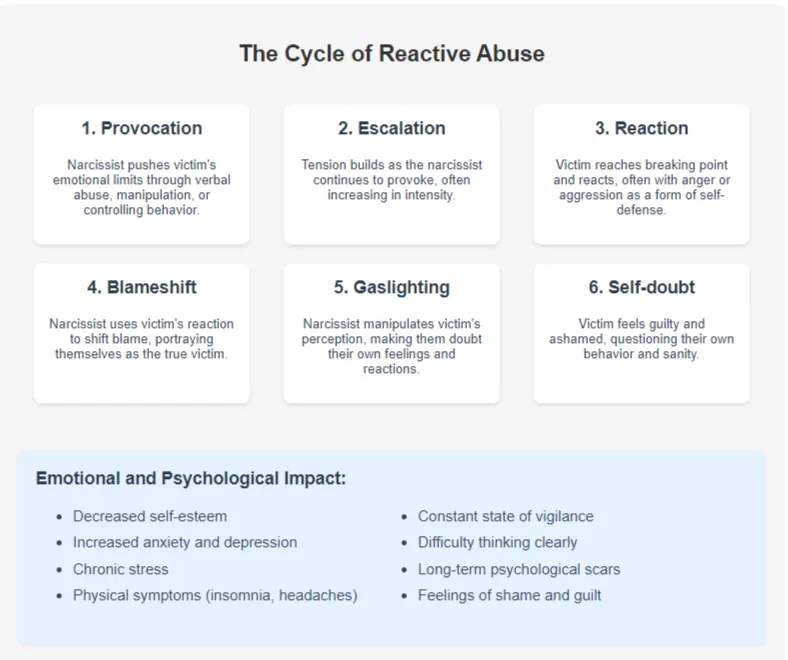
Sustained provocation, then escalation, then a reaction that finally comes out sideways. Then the blame shifts, your reaction becomes the subject, and you are left doubting whether you were ever the one being harmed.
The reaction is usually out of character and it is usually the only part that got witnessed. That combination is what makes it so effective.
Is “reactive abuse” even the right name?
Worth asking early, because the term is contested and you will meet the argument eventually.
The objection is that it calls a victim’s response “abuse”. Advocates who work in this field point out that describing someone’s breaking point with the same word used for a sustained campaign against them does that person no favours.
That objection is a good one. Some prefer “reactive aggression” or “resistive violence”, and those are more accurate descriptions of what actually happened.
The term survives anyway because it names something people recognise. If you searched it, you were probably looking for permission to stop thinking of yourself as an abuser.
Use whichever word helps. What matters is the distinction in the next section, and that one is not a matter of vocabulary.
Is your reaction the same as their abuse?
No, and there is a research framework that explains why rather than just reassuring you.
Violence between partners is not one category. Researchers distinguish situational couple violence, which arises from a specific conflict, from intimate terrorism, which is a sustained pattern of control that violence serves.
A 2020 meta-analysis of 149 studies tested risk markers across both, in clinical and general population samples.
Markers of intimate terrorism, meaning control, power, jealousy and patriarchal beliefs, were significantly stronger in the clinical samples. The authors concluded the two are better understood as a continuum, with intimate terrorism more severe because of its controlling nature.
Read the deciding variable there. It is not who raised their voice, or who was louder, or even who made contact first. It is whether a pattern of control is present.
One person shouting after two years of being undermined, and one person running a campaign that produced the shouting, are not doing the same thing. The single incident looks symmetrical. The pattern is not.
That is the answer to the question you came with. Losing your temper does not make you an abuser. It makes you a person who was pushed past the point where composure was available.
If the provocation was mostly words, verbal abuse covers how to recognise and record it.
Why does the reaction get believed instead of you?
Because the reversal that follows it has been tested, and it works on people who were not there.
A 2023 experiment in the Journal of Interpersonal Violence showed 230 participants scenarios where a perpetrator either used DARVO, meaning deny, attack, reverse victim and offender, or did not.
Participants who saw DARVO rated the perpetrator as less abusive and more believable. They rated the victim as more abusive and less believable, and were more willing to punish the victim.
That is the mechanism, measured. Your reaction supplies the raw material, and the reversal does the rest. Onlookers move toward the calm person telling a tidy story and away from the visibly distressed one.
The limits are worth stating: the scenarios were fictional and the participants were undergraduates. It shows the tactic shifts judgements under test conditions rather than proving what happened in your case.
Two practical consequences follow. You will not win by explaining, because the explanation sounds like exactly what they said you would say. And the calmer you are afterwards, the more the earlier outburst stands alone as the only visible event.
DARVO covers that sequence in full.
Why it is so effective at silencing you
The shame does more damage than the incident.
Once you have behaved in a way you are ashamed of, you have a reason to stop telling people. You edit the story, or you stop telling it, because any honest version includes the part where you shouted.

That silence is the actual product. Not the argument they won, but the year of things you did not mention afterwards because of one thing you did.
It also gets kept and reused. A single incident becomes the permanent reference point, produced whenever you raise something new.
Silence of that kind rarely stands on its own either. It usually arrives with the hypervigilance, self-doubt and disrupted sleep that narcissistic abuse syndrome describes, which is survivor vocabulary rather than a clinical category.
The provocation often begins as their own narcissistic rage, which then gets recast as yours.
How do you prove reactive abuse?
This is asked constantly, usually because something has reached lawyers, and the honest answer is that you mostly cannot prove it as a single event.
What you can do is establish a pattern, because the pattern is what distinguishes the two things above.
Document the ordinary days, not the incidents. A record that contains only the times you reacted describes you badly. A record of the small things over months describes the situation accurately.
Write contemporaneously and factually. Dates, what was said, what happened. No adjectives, no conclusions.

Keep it somewhere they cannot reach, and outside any shared account or device.
Do not edit out your own reaction. A record that admits what you did is far more credible than one that does not, and the omission is what gets found.
Get advice from someone who knows your jurisdiction. Where authorities assess these situations, many use a predominant aggressor standard rather than simply asking who did what, and that is a conversation to have with a professional rather than a website.
How do you deal with reactive abuse?
You deal with it by removing the material it runs on, which is your reaction, rather than by trying to control yourself better under the same pressure.
Leave before the point where you react. Not to be the bigger person. Because the reaction is what gets used, and denying them the material is the whole game.
Learn your own tell. Most people have a physical signal that arrives before the outburst. Heat, a tightening, a shift in your voice. That signal is your exit cue.
Do not respond in a channel they are recording. Messages designed to provoke exist to produce an exhibit.
Stop apologising for the pattern. Apologise once, specifically, for the thing you actually did, if you want to. Then stop. Repeated apology becomes an admission that the whole situation was yours.
Expect the provocation to increase when you stop reacting. Removing the reward intensifies the behaviour before it fades, and here that means escalation aimed at getting the reaction back.
Get one person who knows the whole story, including the part you are ashamed of. Being known accurately by one person undoes a great deal of the isolation.
Where this is the shape of the relationship, grey rock and a proper exit plan matter more than better self-control in the moment.
Common questions
Does reacting make me an abusive person? No. The research distinguishes conflict from a pattern of control, and the deciding factor is control rather than a single incident.
What if I reacted more than once? Repeated reaction to repeated provocation is still reaction. What would change the picture is whether you were also controlling, monitoring or isolating them.
What if I genuinely hurt them? Then that part is yours to own, separately and without it settling the larger question. Both things can be true, and owning your piece does not concede theirs.
Why do they seem so calm during it? Because for them the exchange is going well. Calm is easy when the outcome you want is the other person losing composure.
Should I tell people what I did? Tell one person everything. Telling everyone invites the reversal, and telling nobody leaves you alone with the shame.
Is reactive abuse the same as self-defence? Legally they are different, and that distinction matters enough to need local advice rather than a general answer.
What to take from this
The ten seconds you cannot stop replaying are not the story. They are the part of the story that was visible.
The research is clear that a pattern of control is what separates an abusive relationship from a bad argument.
That is a distinction about the whole situation, rather than about your worst moment inside it.
You reacted because the pressure was real. That does not make the reaction good, and it does not make you the thing you are afraid you might be.
Where to go next. DARVO covers the reversal that follows, and smear campaign covers what happens when it is told to other people.
Gaslighting covers the sustained undermining that usually precedes the moment you reacted.
Stonewalling covers one of the most common provocations: the conversation shut down at exactly the point you needed it resolved.
The grey rock method is the practical tool for not supplying the material.
If you want structured support with the shame specifically, the 8 week narcissistic abuse recovery program is built for it. If there is any question of danger, start with crisis support.
Coaching is not therapy and is not a substitute for medical or psychiatric care. If you are in crisis, please use the support resources on this site or contact your local emergency services.