Dorsal Vagal Shutdown: What It Really Is
The collapse people call dorsal vagal shutdown is real and well documented. The theory behind the name is not. What the evidence supports, and what helps.

You are not upset. You are not panicking. You are just gone.
The body is heavy, the room is far away, and someone is asking you a question you can hear but cannot answer. Afterwards you cannot explain why you did nothing.
That state is real, it is well documented, and it has a name in the research. The name is not “dorsal vagal shutdown”, and the difference turns out to matter.
What is dorsal vagal shutdown?
The term comes from polyvagal theory, where the dorsal branch of the vagus nerve is said to produce collapse, numbness and immobility when threat becomes inescapable.
As a description of the experience it is accurate. People do collapse, do go numb, and do become immobile.
If you are here because it is happening to you, the short answers come first. The state is real. It is not dangerous in itself, and an acute episode usually passes within minutes to hours.
The common signs are heaviness, flatness, slowed speech, a sense of distance from the room, and being unable to act even when you want to. The exception is actual fainting, which needs a medical check, and the section on danger below explains why.
As an explanation of the mechanism, it now has a serious problem, and almost nothing else written on this term will tell you about it.
Is polyvagal theory actually correct?
No, according to a large expert evaluation published in February 2026, and this is the most important thing on this page.
Thirty-nine specialists in vagal physiology and vertebrate evolution were invited to evaluate polyvagal theory. All but one accepted, and the one who declined said they were unfamiliar with it.
Many of them had been cited in the polyvagal literature as supporting the theory.
They assessed five core elements. One was whether respiratory sinus arrhythmia really measures vagal drive to the heart.
Others covered the theory’s account of the two brainstem vagal nuclei, and its claims about how the vagus nerve evolved.
Their conclusion was that major tenets are not supported by past or current knowledge, that several are inconsistent with the broader evidence, and that the theory is untenable.
They also noted something worth repeating. The psychological parts of the theory largely come from older psychological literature, and are not strengthened by the polyvagal constructs layered over them.
Read that carefully, because it is good news rather than bad. The experiences the theory describes were documented before it existed. Losing the theory does not lose them.
So is the shutdown real?
Yes, and the evidence for it is considerably better than the evidence for the theory named after it.

The framework that holds up is the defense cascade, set out in a 2015 review in Harvard Review of Psychiatry.
It describes a sequence of innate, automatic defensive responses. Arousal comes first. Then flight or fight, the active responses.
Freezing is flight-or-fight put on hold, not shutdown. You are still alert, still ready to move, just held.
Tonic immobility and collapsed immobility are responses of last resort, used when threat is inescapable and the active defences have already failed.
Then quiescent immobility, a state that supports rest and healing afterwards.
Each has a distinct neural signature involving the amygdala, hypothalamus, periaqueductal gray, and both sympathetic and vagal nuclei. The vagus is genuinely involved. It is simply not the whole story, and not in the way the popular version says.
Freeze and shutdown are not the same thing
Almost every article uses these interchangeably. The review above does not, and the distinction is practically useful.
Freezing is alert immobility. Heart racing, muscles ready, attention narrowed. You are holding still because moving is not yet the right call.
Tonic immobility is unresponsive immobility. Rigid or slack, unable to speak or move, often with altered awareness. This arrives after active defence has failed.
Collapsed immobility goes further, toward fainting and loss of postural tone.
If you have been told you “went into freeze” during something serious, you may actually be describing tonic immobility. That distinction matters in the next section more than anywhere else.
Why did I not fight back?
This is the question underneath the search, and it has a direct evidence-based answer.
A 2024 review in Violence Against Women states that there is widespread scientific evidence validating tonic immobility as part of the trauma response in victims of rape.
The paper’s actual subject is the law. It reviews US law and policy and argues that legal and policy definitions of consent do not fully recognise tonic immobility as evidence of non-consent, and that they should.
Two things follow from that, and both are worth having.
Your body did something documented. Not freezing out of weakness, not consenting, not failing to resist. A recognised involuntary defensive response that the research literature validates.
The law has been slower than the science. If you have been made to feel your stillness undermined your account, that gap is the reason, and researchers are actively arguing it should close.
What does dorsal vagal shutdown feel like?

Descriptions are consistent enough to be recognisable.
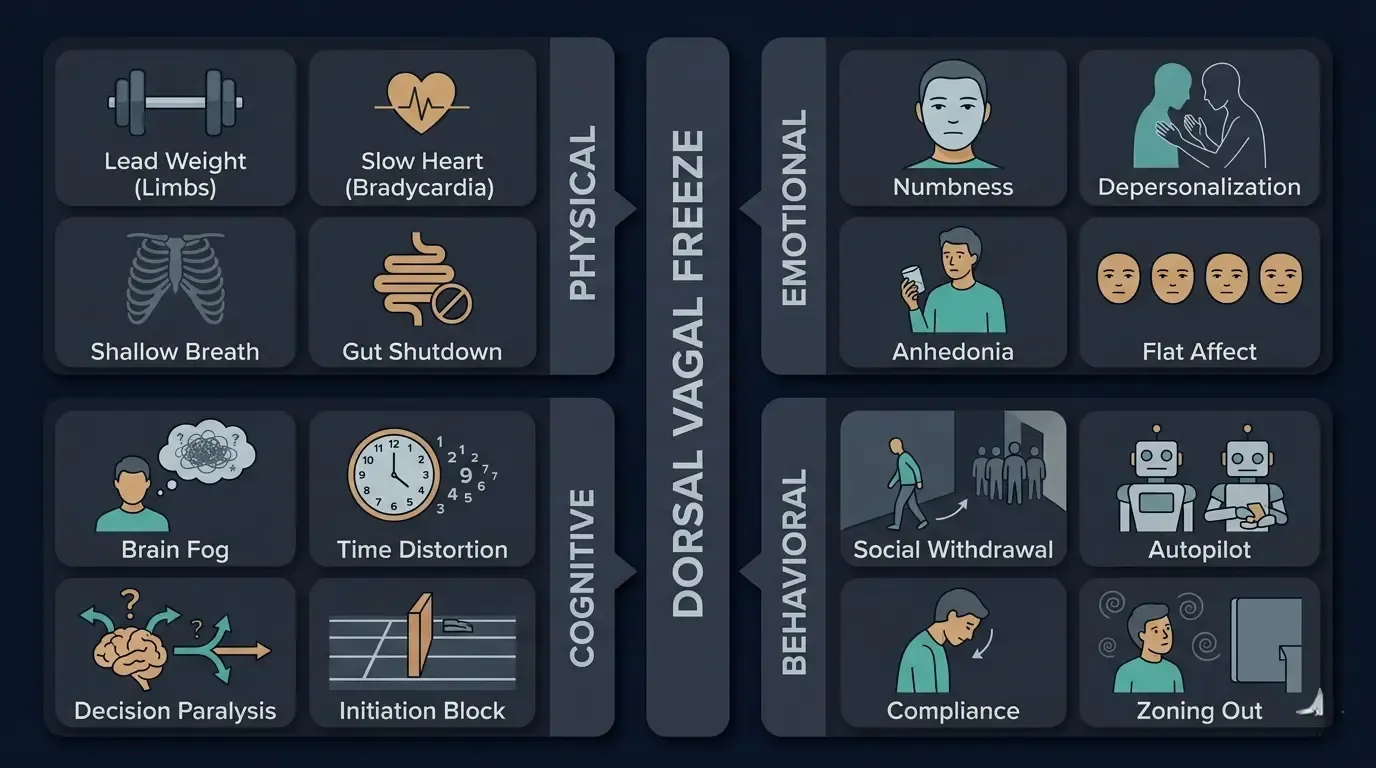
- Heaviness. Limbs feel weighted, and standing up is a project.
- Distance. The room, your own voice, and other people all seem further away than they are.
- Blankness. Not sadness. An absence where the feeling should be.
- Speech going. Words are there and will not come out, which is not the same as not knowing what to say.
- Time distortion. An hour missing, or a few minutes that lasted much longer.
- No initiation. You know exactly what needs doing and cannot start it.
- Compliance. Going along with things because objecting requires an energy that is not available.
The last one is why this matters in abusive relationships specifically. Shutdown looks like agreement from outside, and it later gets described that way.
Is dorsal vagal shutdown dangerous?
A common search, and it deserves separating into two answers, because Google itself confuses these.
The psychological shutdown described here is not medically dangerous in itself. It is unpleasant and disabling, and it passes.
Fainting is a different matter. People searching this term often land on results about vasovagal syncope, which is an actual medical event involving a drop in heart rate and blood pressure.
Those are not the same thing, and this is the one place where getting it wrong could cost you.
If you are actually losing consciousness, get it assessed medically. Fainting has causes that include cardiac ones, and none of them should be explained away as a trauma response without a doctor ruling them out first.
The same applies if shutdown states are frequent, last for days, or come with chest pain, palpitations or breathlessness. That is a GP conversation, not a nervous-system-regulation conversation.
How do you come out of a shutdown state?

Honestly, with less certainty than the internet offers. The 2015 review’s principle is to shift one component of the pattern rather than to fix the whole state at once.
Start smaller than feels reasonable. Move one hand. Change the angle of your head. Something the size of what is available, not what you think should be available.
Use weight and temperature. Pressure, a blanket, something cold to hold. These give the system input when nothing else is landing.
Get orientation before you get insight. Naming objects in the room does more here than understanding what happened.
Be with someone, without being asked questions. Company that does not require performance is one of the few things people reliably report helping.
Do not try to think your way out. Analysis is the thing least available in this state, and reaching for it usually adds shame.
Afterwards, eat and sleep. The cascade’s last stage exists to support recovery. Treat the aftermath as convalescence rather than as lost time.
For the general regulation work outside these episodes, nervous system regulation covers what actually has evidence behind it, which is a shorter list than most sites suggest.
If the shutdown arrives with a wave of old shame or fear, you may be in an emotional flashback.
What causes it in abusive relationships?
Because inescapability is the trigger, and that is the defining feature of the situations this site covers.
The cascade reaches its last resort when active defence has failed. In a relationship you cannot leave, argue with, or successfully appeal to, active defence fails repeatedly.
So the system stops trying earlier each time. What began as a response to serious threat starts arriving during ordinary disagreements.
That is also why it overlaps with the fawn response. Appeasement and shutdown are both what remains when fighting and fleeing are unavailable.
And it is why stonewalling can be genuine rather than strategic. A person who is shut down is not choosing silence.
Is this dissociation?
Often, yes. The two words describe the same territory from different angles.
Shutdown describes the physiology. Heart rate drops, energy collapses, the body goes quiet.
Dissociation describes the experience. A sense of distance from yourself or from the room.
Clinically it is usually split into two things worth being able to name.
Depersonalisation is detachment from yourself. Your hands look like they belong to someone else. You hear yourself talking from slightly behind your own head.
Derealisation is detachment from the surroundings. The room feels staged. Colours are flat. People seem like they are on a screen.
Neither of these means you are losing your mind. That is worth stating plainly, because it is the fear that stops people mentioning it to anyone.
Why it happens during abuse
It is a defence, and it is extremely effective at what it does.
When escape is not available and fighting is not survivable, reducing your presence in the experience is the remaining option. Dissociation makes an unbearable situation bearable in the moment. That is not weakness and it is not a character flaw.
The cost arrives later. Gaps in the record. Whole months you cannot account for. A feeling of having watched your own life from the corner of the room.
Then the most painful part. A sense that you cannot fully vouch for your own account of what happened, which makes it very hard to describe to anyone else.
When it needs proper attention
Brief episodes during and shortly after abuse are common, and they usually settle as safety returns.
Get clinical help if it happens when you are not under stress, if you are losing time rather than losing focus, if it is getting more frequent months after the situation ended, or if you cannot come back from it using the grounding described above.
Persistent dissociation is treatable. It is also not something to work on alone, and the trial-and-error approach that suits ordinary regulation work is the wrong tool for it.
Common questions
How long can dorsal vagal shutdown last? Minutes to hours for an acute episode. Longer flatness usually reflects something else, including depression, and is worth having assessed.
Is it the same as dissociation? They overlap heavily and are described in different literatures. Tonic immobility often includes altered awareness, which is what most people mean by dissociating.
Can dorsal vagal shutdown kill you? The psychological state, no. Genuine fainting or collapse needs a medical assessment, because the causes of syncope are not all benign.
Is it depression? Not the same thing, though they can look alike and can coexist. Shutdown is episodic and threat-linked, while depression is more sustained.
If polyvagal theory is wrong, was my therapist wrong? Not necessarily. Clinicians using it are usually describing states that genuinely exist, with a model that has become unreliable. The techniques do not stand or fall with it.
Why can I not just push through it? Because the response runs below deliberate control. That is what makes it a defence rather than a decision.
What to take from this
The experience is real, common, and documented. The label attached to it comes from a theory that a large expert consensus has now found untenable.
Keep the observation, drop the mechanism. The defense cascade describes what happens, with better evidence and more precision, and it distinguishes freezing from tonic immobility in a way the popular version does not.
If you went still during something serious, you were not consenting and you were not weak. The research validates that response, and the law is being argued into catching up.
And if you are genuinely fainting, see a doctor before you accept any explanation offered here or anywhere else.
Where to go next. Nervous system regulation covers what actually helps between episodes, and the fawn response covers the appeasement side of the same cascade.
What abuse does to your body covers what sustained threat leaves behind after the episodes stop.
If you want structured support, the 8 week narcissistic abuse recovery program is built for it. If there is any question of danger, start with crisis support.
Coaching is not therapy and is not a substitute for medical or psychiatric care. If you are in crisis, please use the support resources on this site or contact your local emergency services.