The Narcissistic Family System
Roles are assigned, not earned, and they rotate. How the structure holds itself together, what happens when one person leaves, and what the data says.
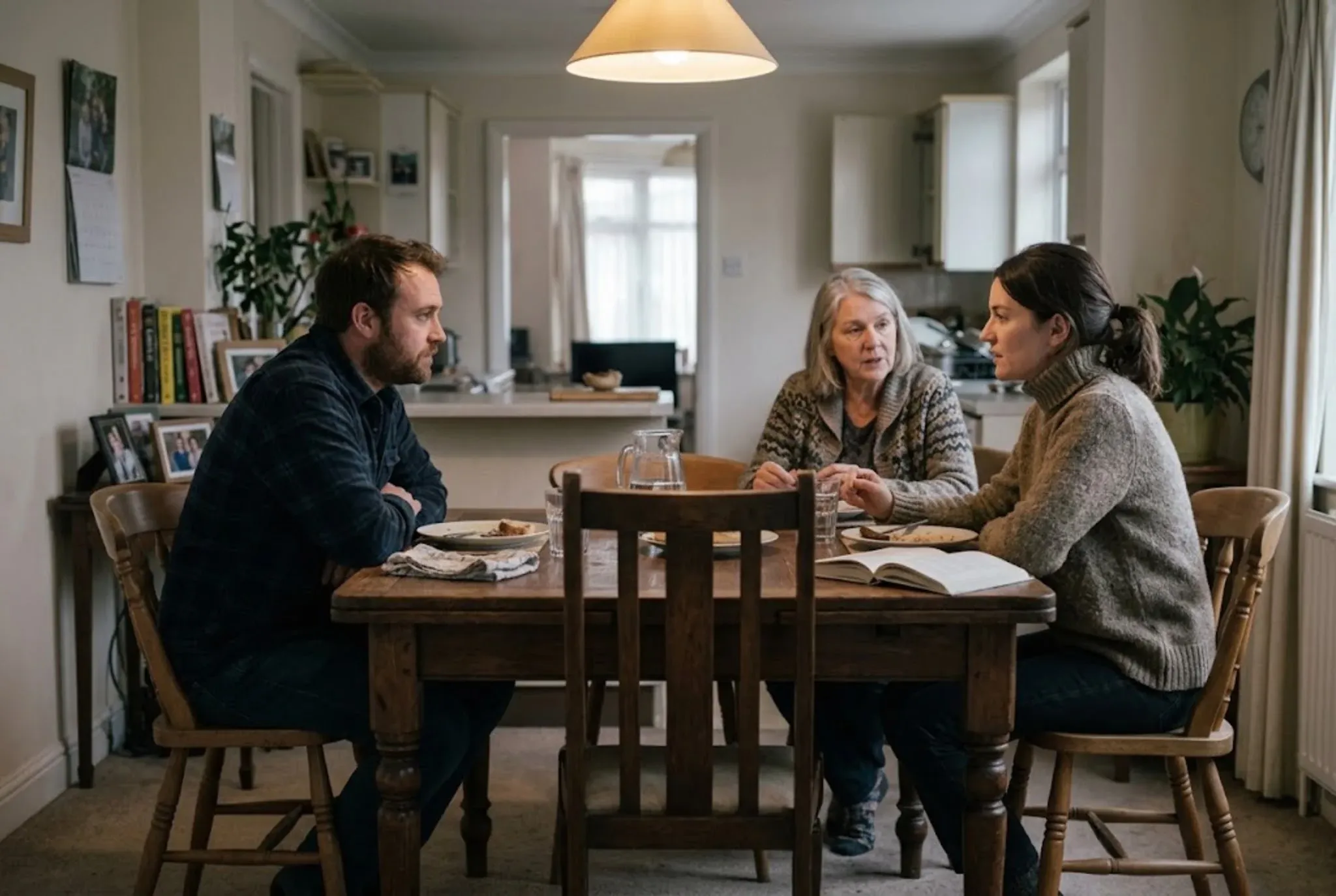
A narcissistic family is not a family with a difficult person in it. It is a structure that assigns roles to children and then requires them to keep playing those roles for the system to stay stable.
The roles are not descriptions of who the children are. They are jobs. And they can be reassigned without warning, which is the part almost nobody explains.
If you have ever wondered why you were the problem child in one decade and the reliable one in the next, that is the system working exactly as designed.
What is a narcissistic family system?
It is a family organised around one person’s emotional state.
In an ordinary family, the adults regulate the children. In this one, the children regulate the adult. Every role in the house exists to manage the parent’s image, mood or need for supply, and the children are sorted into whichever function serves that best.
Three features define it.
Roles, not relationships. Each child is given a fixed function. Praised, blamed, ignored, or used as the peacemaker. Their actual personality is largely irrelevant to which one they get.
A single reality. There is one account of what happens in the house, and it belongs to the parent. Disagreeing with it is not a difference of opinion, it is disloyalty.
Contact between siblings is routed through the parent. Children in these families often have no direct relationship with each other. Everything they know about a sibling arrives filtered.
That third feature is the one that keeps the system running long after everyone has grown up.
What are the roles in a narcissistic family?
Four appear most often. Read them as job descriptions rather than personality types.
The golden child carries the parent’s image. Their achievements are the parent’s achievements, and their failures are unacceptable for the same reason. The reward is real and it is conditional on performance.
The scapegoat carries the blame. Every problem in the family has a designated cause, and it is them. The family scapegoat role is covered in depth on its own page, including why it is often the child who told the truth.
The invisible child, sometimes called the lost child, carries nothing. They are the one who learned that the safest position in the house was out of frame. They caused no trouble, asked for nothing, and were praised for being easy.
The mascot or the peacemaker carries the tension. They defuse, they joke, they change the subject, and they read the room before anyone speaks.
The roles rotate
This is the piece that gets missed, and it explains a lot of confusion.
Roles are assigned by function, not by merit. When the golden child sets a boundary, they can become the scapegoat within a single conversation. When the scapegoat leaves, the role does not disappear. It is handed to whoever is left.
Families do not tolerate a vacancy in the scapegoat position. If you leave and a sibling who was previously safe suddenly becomes the family’s problem, the system did not change. The casting did.
Some children are cast as the family’s carer or confidant. Parentification covers that role.
Is the golden child actually harmed?
Yes, and the mechanism is worth being precise about.
A meta-analysis of parental differential treatment pooled 215 effect sizes from 13 samples to ask what actually drives the difference between siblings raised in the same house.
The finding that matters: differential hostility had a stronger association with sibling differences in behaviour problems than differential warmth did.
Read that carefully, because it inverts the usual story. The damage is not mainly that the golden child received more love. It is that the scapegoat received more hostility. Those are different mechanisms with different consequences.
What the golden child gets instead is a self-worth that is entirely performance-contingent. No permission to fail. A relationship with the parent that ends the moment they become inconvenient.
Many golden children discover this in their thirties, when they say no for the first time. The mechanism holding them in place is usually enmeshment.
Neither role is a good outcome. Comparing damage between siblings is one of the ways the system keeps them apart.
What happens to the invisible child?

The invisible child gets described as the one who escaped, usually by the family.
What actually happened is that they solved the problem by removing themselves from the equation, and that solution keeps running for decades after it stops being necessary.
The adult version is recognisable.
- They do not ask for things. Not out of politeness. Asking was never a strategy that worked.
- They are extremely accurate readers of other people. Attention that is not being spent on your own needs goes somewhere, and it usually goes into monitoring the room.
- They are self-sufficient past the point of usefulness. Help is refused reflexively, including help they need.
- They minimise. Ask what their childhood was like and you get “fine, I was the easy one”.
- They are late to want things. The question of what they actually want was never asked, so it takes years to develop an answer.
The invisible child usually has the least corroboration of anyone in the family. The scapegoat at least has a story about being blamed. The invisible child has no incidents to point to, only an absence, and absences are very hard to describe to anyone who was not there.
This overlaps closely with self-abandonment, which is the adult pattern the role trains for.
How does the system keep everyone in it?
Through triangulation, and this is measurable rather than theoretical.
A study of 301 families examined triangulation, where a parent draws a child into conflict between the adults or between the child and another family member.
The pattern is simple to describe and hard to see from inside it. Two people never speak directly. Everything passes through a third.
In practice a parent tells you what your sister said about you. They tell your sister a different version of what you said. They remain the only person who knows both accounts. Nobody has to lie for this to work. Selective reporting is enough.
The result is a family where siblings who would be natural allies do not trust each other. The only person with a full picture is the person the system serves. If you want the mechanism in detail, narcissistic triangulation covers how it operates in relationships generally.
This is why sibling reconciliation so often happens after the parent dies or after contact ends. Remove the router and the siblings can finally compare notes.
Should I stay in contact for my siblings?
The data on this is better than you would expect, and it is uncomfortable.
Researchers using national longitudinal survey data compared health outcomes across three kinds of relationship between mothers and adult children: socially positive, socially negative, and estranged. The sample covered 2,609 mothers and 5,590 adult children.
“Socially negative” means high contact and low quality. That is the arrangement most people in narcissistic families settle for.
Three findings.
Adult children in socially negative ties had worse health than those in socially positive ties. Staying in touch is not automatically protective. High contact with a bad relationship carries a measurable cost.
Estranged adult children’s mental health was not statistically different from those in socially positive ties. On depression scores specifically, the estranged group looked like the group with good relationships.
On general self-rated health, the estranged group looked more like the socially negative group. So this is not a clean endorsement of cutting off, and it should not be reported as one. Estrangement carries its own load.
The finding most relevant to your question is about siblings directly. Their own relationship with the mother mattered more than the sibling context. What your siblings are doing matters less to your outcome than your own tie does.
That does not decide it for you. It does mean the argument “I have to stay for my brother” is weaker than it feels. The cost of a high-contact low-quality arrangement is not zero.
If you are weighing this, no contact covers what the decision actually involves, and boundaries with a narcissist covers the middle option where full separation is not available.
What does leaving the system look like?

Rarely like a decision. Usually like a slow reduction that the family notices before you have named it. Family estrangement covers what that path tends to look like over time.
Four things happen with some reliability.
The system escalates before it accepts. Reduced contact reads as a threat to the structure, so the pressure increases first. More calls, more intermediaries, more messages from relatives who have never contacted you before.
Your role gets reassigned to someone else. Covered above. Expect it, and expect to feel guilty about it.
Your account gets rewritten. The story becomes that you are unwell, ungrateful, difficult, or influenced by your partner. This is a smear campaign operating inside a family rather than a friend group, and it works the same way.
Some siblings will side with the system. Not because they do not believe you. Because their position in the family depends on the parent’s version being true, and they have more to lose than you do.
Common questions
How do I know if I grew up in a narcissistic family system? The clearest test is not how the parent behaved. It is whether the children had roles, whether reality was singular, and whether siblings communicated through the parent rather than directly. If all three are true, you were in a system rather than a difficult household.
Can a whole family be narcissistic? The structure can be, without every member having narcissistic traits. Most people in these families are participating in a pattern rather than driving it, which is why some of them change once the pattern is no longer enforced.
Was it my fault I was the scapegoat? No. Roles are assigned by system need, not by behaviour. The most common reason a child becomes the scapegoat is that they noticed something and said so.
Do narcissistic families ever change? The system changes when it stops working, which usually means when enough people stop playing their parts. Individuals change more readily than the structure does. Expect the parent to be the last thing that shifts, if it shifts.
Why do my siblings remember it completely differently? Because they were in different roles and received different information, much of it routed through the same person. Different memories are the expected output of a triangulated family, not evidence that you invented yours.
What to take from this
You were given a job in a structure that needed one filled. It was not a description of you, and it was not earned.
Two things are worth knowing. The roles rotate, so your position was never as fixed as it felt. And the sibling relationships you lost were engineered rather than natural.
The person you would have been without the assignment is still available. That work starts by noticing which of your current habits are still doing a job that ended years ago.
Coaching is not therapy and is not a substitute for medical or psychiatric care. If you are in crisis, please use the support resources on this site or contact your local emergency services.