Parentification: Signs, Types and Effects
Parentification is when a child becomes the parent: emotional confidant, carer or family manager. The signs, the two types, what research shows, and healing.
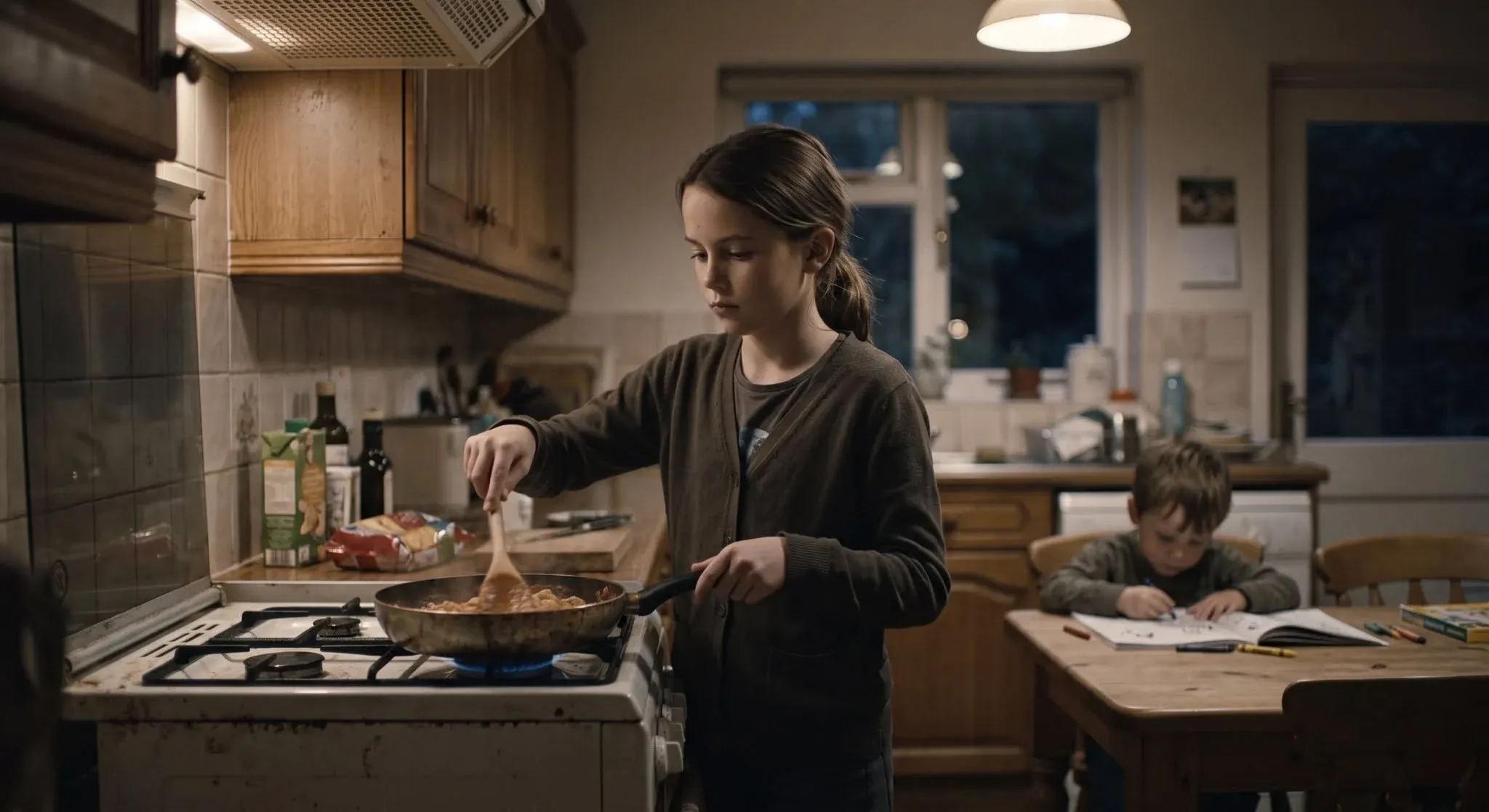
You were the sensible one. The one who calmed your mother down, kept track of the bills, got your siblings to school, or listened while a parent cried about their marriage.
People praised you for being mature. Nobody asked who was looking after you.
That is parentification: a child taking on the job of a parent. It is common, often invisible, and its effects are more varied than most articles admit.
What is parentification?
Parentification is a role reversal in which a child takes on responsibilities that belong to an adult, usually to meet a parent’s practical or emotional needs. The child becomes a carer, confidant, mediator or substitute parent, instead of being cared for.
The key word is inappropriate. Children helping at home is healthy. Parentification is when the load is too heavy for the child’s age, goes on for years, and comes without recognition or support.
A 2023 review of 95 studies found parentification described on six continents. It is not a niche problem.
What are the two types of parentification?
- Instrumental parentification: Practical adult tasks. Cooking, cleaning, managing money, translating for parents, caring for a sick parent, raising younger siblings.
- Emotional parentification: Meeting a parent’s emotional needs. Being their confidant, comforting them, mediating between parents, keeping adult secrets, managing their moods.
Emotional parentification is both more common and more damaging. In a study of nearly 48,000 Polish adolescents, 36% reported emotional parentification towards a parent, compared with 7% for instrumental. The authors note that in US research, emotional parentification is the most harmful form.
That makes sense. Doing the laundry at ten is tiring. Being your mother’s therapist at ten reshapes how you understand love.
What are the signs of a parentified child?
- Adult worries at a young age: Money, a parent’s health, whether the marriage will last.
- Being a parent’s confidant: Hearing about their loneliness, their affairs or their partner’s failings.
- Mediating between parents: Carrying messages, calming fights, choosing sides.
- Raising siblings: Doing homework help, meals and bedtimes as a regular job, not an occasional favour.
- Hyper-maturity: Adults describing you as “an old soul” or “eight going on forty”.
- Guilt when you have fun: Play feels irresponsible, because something might go wrong while you are not watching.
- Hiding your own problems: You did not want to add to their load.
What does parentification look like in adults?

- Over-responsibility: Everyone’s problems feel like yours to solve.
- Difficulty receiving care: Being looked after feels uncomfortable, even suspicious.
- People pleasing: You read what others need before they say it.
- Hyper-independence: Asking for help feels risky or weak.
- Attraction to people who need rescuing: Partners who need fixing feel familiar.
- Burnout: You carry too much for too long, then collapse.
- Resentment you feel guilty about: Anger at a parent you also feel responsible for.
A parentified daughter often becomes the family’s emotional manager in adulthood: organising, remembering, smoothing things over. Parentified sons are sometimes cast as the “man of the house” after a father leaves. The dynamics differ, but both involve a child standing in for an adult.
Is parentification a form of trauma or abuse?
It can be. It depends on how heavy the load was, how long it lasted, and whether the child was supported and recognised.
Here the research is more honest than most articles. A 2011 meta-analysis of 12 studies with 2,472 adults found childhood parentification was linked to adult psychological problems. The link was reliable but small. Factors like the type of sample and how parentification was measured changed the size of the effect.
A 2024 meta-analysis of 478 studies of blurred parent-child boundaries found the child-as-caregiver pattern was linked to children’s difficulties. That link was weaker than for enmeshment, where the parent intrudes on and controls the child’s inner life.
So parentification is a real risk, not a guaranteed injury. It is much more likely to be harmful alongside neglect, or a parent’s addiction or mental illness. The same goes for a narcissistic parent who treats the child as a resource.
Emotional neglect often travels with it. Childhood emotional neglect covers the signs it leaves in adults.
Can parentification cause CPTSD? On its own, it is not usually described as a cause. It often happens alongside the kinds of prolonged, relational adversity that are linked to complex trauma, and some adults describe symptoms that fit it.
Can parentification have any positive effects?
Yes, and it is worth saying clearly, because it helps people make sense of mixed feelings.
The 2023 review found that some parentified young people experienced positive outcomes, such as better coping. Perceived benefits and outside support shaped how things turned out.
In the Polish study, 61% of adolescents reported satisfaction with their caregiving roles, while about 15% reported a sense of injustice. A separate Polish study found instrumental parentification was actually linked to better school grades, through higher quality of life.
Culture matters too. In a US study of low-income families, parentification predicted mostly negative outcomes for European American youth. For African American youth, emotional parentification was linked to a better parent-child relationship. The authors concluded its effects depend on the cultural context.
The pattern that emerges: contributing to a family that values and supports you can build competence. Being used to fill an adult’s emptiness usually does not. Many adults had some of both, which is why the feelings are so tangled.
How is parentification different from enmeshment?
They overlap, but they are not the same.
Parentification is about roles: the child does the parent’s job. Enmeshment is about boundaries: the parent treats the child’s thoughts, feelings and choices as their own.
A child who is their mother’s confidant is often both parentified and enmeshed. Enmeshment covers that side in depth.
How do you heal from parentification?

- Name what happened without needing it to be the worst thing. You can acknowledge the load was too heavy without calling your parent a monster.
- Grieve the childhood you did not get to have. Play, carelessness and being looked after are real losses.
- Notice where you are still on duty. Which relationships do you manage, monitor or rescue? Which ones would collapse if you stopped?
- Practise receiving. Let someone help you with something small, and resist the urge to repay it immediately.
- Hand back what is not yours. Your parent’s loneliness, their marriage and their moods belong to them. Boundaries with a narcissist covers how to hold that line when it is pushed.
- Keep the strengths. Competence, empathy and reliability are real. You get to keep them and use them by choice, not obligation.
- Get support if it is heavy. Therapy helps when parentification sits alongside abuse, neglect or lasting symptoms.
How do you set boundaries with a parent who parentified you?
The hardest part is that your parent may still expect the old arrangement. They call you first in every crisis. They still confide in you about their relationships.
Start small and specific. “I’m not able to talk about your marriage. I love you, and I’m glad you have friends for that.” Then change the subject, or end the call.
Expect guilt, from them and from inside you. Guilt tripping covers why it lands so hard and how to hold steady.
Common questions
What does it mean to be parentified? It means you took on a parent’s role as a child, practically, emotionally or both, in a way that was too much for your age.
Is it parentification if I helped with my siblings? Not necessarily. Occasional help is normal. It becomes parentification when you were effectively their parent, for long periods, without support.
What is a parentified eldest daughter? Eldest daughters are often given the most responsibility for siblings and a parent’s emotions. The “eldest daughter” experience that people describe online frequently overlaps with parentification.
Can a parentified child have a good relationship with their parent later? Yes, especially if the parent can acknowledge what happened. Many parents who leaned on a child were struggling themselves, and some can hear it.
Is parentification common in narcissistic families? Yes. A narcissistic parent often uses a child for comfort and admiration, which is a form of emotional parentification. The narcissistic family system covers how the roles get assigned.
Does parentification affect relationships? Often. Many parentified adults over-give, choose partners who need rescuing, and struggle to accept care. Recognising the pattern is the first step to changing it.
What to take from this
Parentification is not always abuse, and it does not always leave damage. The research is clear on that, and it is worth hearing if your feelings about your childhood are mixed.
What does the damage is being used rather than valued, and carrying a load nobody noticed.
You were a child doing an adult’s job. You do not have to keep doing it now.
Where to go next. Emotionally immature parents covers the kind of parent who often leans on a child, and the fawn response covers the caretaking reflex that parentification trains.
Self-abandonment covers the habit of putting your needs last, which many parentified adults recognise.
If you want support learning to put your own life first, the 8 week narcissistic abuse recovery program starts with a free fit call.
Coaching is not therapy and is not a substitute for medical or psychiatric care. If you are in crisis, please use the support resources on this site or contact your local emergency services.