Narcissistic Parents: Signs and Effects
What narcissistic parents do, what the research shows it costs adult children, and why the golden child is not the one who got away with it.
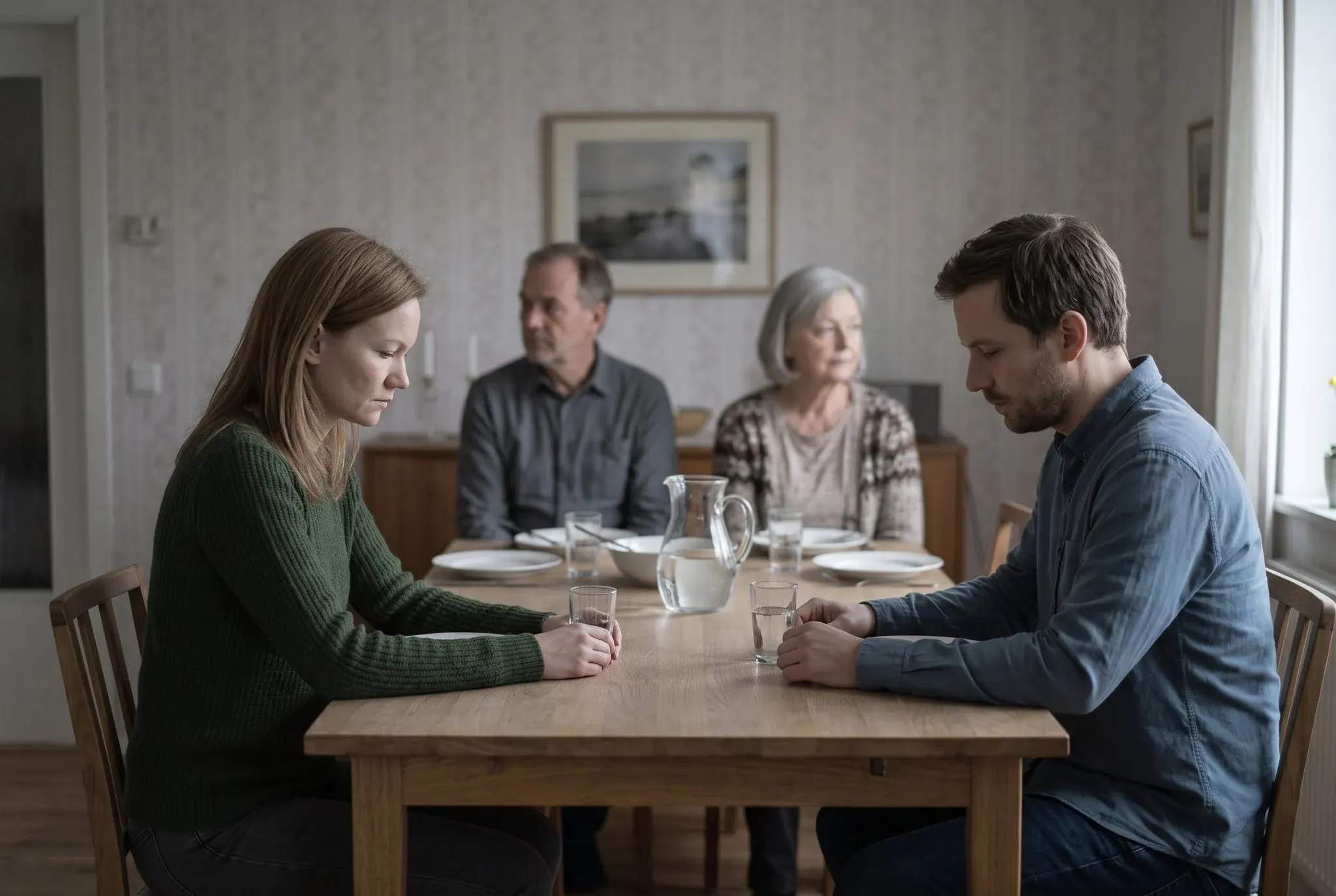
A narcissistic parent needs the family to reflect well on them. Everything else, including you, is negotiable.
Most people arrive at this question late. Usually in their thirties or forties, usually after a therapist says something, and usually feeling disloyal for asking at all.
You are allowed to describe your childhood accurately. That is not the same as blaming anyone, and it does not require you to have had the worst version.
What are the signs of a narcissistic parent?
The behaviours are ordinary enough that they were invisible while you lived in them.

- Your autonomy read as betrayal. Moving out, choosing a partner, or choosing a career they did not pick became an act against them.
- Love arrived on terms. Warmth followed performance, and withdrew when you disappointed them.
- The family had a public version. How things looked mattered more than how they were, and you were expected to maintain the display.
- Your memory was corrected. They remembered a kinder version of every event, which is where gaslighting becomes a household habit.
- You managed their feelings. You learned to read their mood on entering a room, and to adjust yourself before anything was said.
- Help came with an invoice. Money, childcare, and favours were real, and they were later produced as debts.
- There was no repair. Arguments ended by moving on, never by anyone acknowledging harm.
The distinguishing feature is not any single item. It is that the pattern held for years, and that nobody ever came back afterwards to make it right.
How can I tell if my parents were narcissists?
Strictly speaking you cannot, and the attempt is usually the thing keeping people stuck.
A systematic review of prevalence studies put narcissistic personality disorder at an average of 1.06% of adults across seven studies. Diagnosis is rare, and your parent is unlikely to ever seek one.
That leaves you needing a different question. Ask what the behaviour cost you rather than what to call the person.
The behaviours are measurable even when the label is not. That is what the rest of this article is about.
Many difficult parents are not narcissists at all. Emotionally immature parents covers the more common pattern.
What does the research say about the damage?
The relevant construct is psychological control: guilt induction, love withdrawal, and treating a child’s separate perspective as disloyalty.
A 2025 meta-analysis pooled 48 samples covering 27,150 young people across 18 countries. Higher psychological control was associated with higher internalizing symptoms at r = .27.
The effect was stronger when the young person reported it than when the parent did. Parents and children do not describe this behaviour the same way, and the child’s version is the one that tracks the outcome.
Over a longer horizon, a review of 23 longitudinal cohort studies followed childhood exposures into adult diagnoses.
Emotional abuse was significantly associated with adult affective and psychotic disorders. Exposure to multiple forms of maltreatment carried over three times the odds of an adult mental disorder.
These are cohorts, not experiments, so they establish association rather than cause. They are still far better evidence than the survey snapshots this topic usually runs on.
What kind of children do narcissistic parents raise?

The familiar model assigns roles: a golden child who can do no wrong, a scapegoat who carries the blame, sometimes a forgotten one in between.
The roles are real. What the internet gets wrong is who is supposed to have escaped.
A study of 725 adult children across 309 families measured perceived maternal favouritism and disfavouritism in midlife.
Depressive symptoms were elevated in the children who saw themselves as their mother’s greatest disappointment, which is the expected finding.

They were also elevated in the children reporting the most closeness to their mother, and in those reporting the most conflict. Being the favourite conferred no protection.
The authors read this as social comparison rather than fairness. Being singled out costs, in either direction, and the association was stronger in Black than in White families.
A 2024 meta-analysis of differential treatment supplies the mechanism. Across 13 samples, differential hostility mattered more than differential warmth.
The overall effect was small but significant, which is worth saying plainly rather than inflating. Being treated worse than a sibling registers harder than watching a sibling be treated better.
If you were the golden child, you were not spared. You were given a role with conditions attached, and the conditions were the injury.
What happens to adult children of narcissistic parents?

What survivors describe is more specific than the research measures, and it is consistent enough to be worth listing.
You scan. You read a room before entering it, and you register mood changes other people miss entirely.
You apologise pre-emptively. Often for things that are not yours, because apologising early used to shorten the episode.
You do not know what you want. Preference was not safe to have, so you learned to want what was permitted, which is what self-abandonment means in practice.
You over-explain. Every request comes with a justification, because requests used to need defending.
You mistake intensity for love. Someone who is hard to please feels like home, and that familiarity is what trauma bonding runs on later.
You feel guilty when things go well. Success was appropriated or resented, so you learned to keep it quiet.
None of this is a diagnosis. It is a description, and most people find recognising it more useful than naming their parent.
What about a narcissistic father?
Less written about, and the differences are not what people expect.
The behaviour tends to present differently. Fathers in this pattern are more often described as status-driven and openly contemptuous, where mothers are more often described as engulfing.
That is a tendency in how people report it, not a rule, and plenty of families run the other way round. Treat it as a starting point rather than a test.
There is one measured difference worth knowing. A study of 519 children aged 9 to 11 and their parents examined how parental narcissism relates to children’s.
Both parents’ narcissism was linked to overvaluation and to children’s narcissistic traits. But overvaluation only mediated the link for fathers, not mothers.
In other words, fathers appear to transmit it partly by inflating the child, and mothers appear to do it by some other route this study did not capture. The sample was Italian and cross-sectional, so treat it as a lead rather than a conclusion.
It is also the answer to a question people are afraid to ask out loud. Traits do travel between generations, and being aware enough to worry about it is not what transmission looks like.
Do I have to keep them in my life?
No, and the pressure you feel to say otherwise is worth examining on its own.
Most people try reduced contact first, and that is sensible. Shorter visits, fewer calls, nothing personal disclosed.
Reduced contact works when the harm scales with exposure. Where the same pattern reasserts itself in any dose, no contact is what is left.
Be ready for the family response. Relatives who accepted that you left a cruel partner will ask when you are going to forgive your father, and that asymmetry is not about you.
Practical measures that help more than better arguments:
Decide your own actions, not theirs. “I will end the call if this continues” is enforceable, which boundaries covers in detail.
Say less. Detail becomes material. The grey rock method is built for contact you are not ending.
Do not litigate the past at holidays. The setting guarantees an audience and guarantees you lose.
Expect it to get worse before it settles. Escalation after a boundary is the normal response, not evidence you were wrong.
If you are the parent now, sharing children with a narcissistic ex, co-parenting with a narcissist covers how to protect them.
What is inner child work, and does it help?
“Inner child” is a metaphor, not a mechanism, and treating it as an anatomical fact is where the idea goes wrong.
There is no separate younger self living inside you. What the phrase points at is real and simpler than that. Needs that went unmet at five are still shaping how you react at forty, because the rules you learned then were never revised.
A child in a narcissistic house learns specific rules. Do not need anything. Read the adult before you speak. Being useful is how you stay safe. Those rules were correct at the time. They are the reason the house was survivable.
The problem is that nobody tells you when they expire.
What the work actually involves, stripped of the imagery, is three steps.
- Identify the rule. Not the memory. The instruction you took from it.
- Check whether it is still true. Most of them are not. Asking for something now does not produce the consequence it produced then.
- Practise the new behaviour while it feels wrong. It will feel wrong for months. That is the rule being overwritten, not evidence you are doing it badly.
Where I would be careful. Guided visualisations that involve speaking to a younger self can be genuinely useful for some people and can be destabilising for others, particularly anyone who dissociates. If a technique reliably leaves you worse for the rest of the day, that is information about the technique, not about your commitment.
The evidence-based relatives of this work are schema-focused therapy and self-compassion training. If you want the version with clinical support behind it, those are the names to ask a professional about, and inner child work covers what that research actually found.
Common questions
Is one narcissistic parent enough to cause this? Yes, though the other parent’s response matters. A second parent who protects changes the picture considerably, and one who enables does not.
Why does my sibling remember it differently? Because they were given a different role. Different roles produce genuinely different childhoods inside one house.
Will my parent ever admit it? Plan on no. Admission requires the self-examination the pattern exists to avoid, and waiting for it costs years.
Am I going to be like them? The people who ask are the least likely to be. Worrying about your effect on others is the opposite of the trait in question.
What if they are getting old or ill? Care and contact can be separated. You can make sure someone is looked after without being the one who does it.
Is it normal to grieve a parent who is still alive? Yes, and it is the part nobody prepares you for. There is no ritual for it and no date in the calendar, so it simply recurs.
What to take from this
The evidence backs the mechanism rather than the label. Psychological control, emotional abuse, and being singled out within a family all track into adulthood.
The roles were assigned, and none of them was safe. Favourite and scapegoat both show elevated symptoms, which is the finding most articles on this topic leave out.
You do not need a diagnosis for your parent in order to describe your childhood accurately. You lived in the evidence.
Family estrangement covers stepping back from parents, and why it is more common and less final than it feels.
Where to go next. The family scapegoat covers the role in detail, including why the favoured child was not spared either.
Enmeshment covers the opposite problem: a parent who would not let you be separate. Boundaries with a narcissist is the practical starting point, and the covert narcissist covers the quieter presentation many parents fit better than the loud one.
If you want structured support with this, the 8 week narcissistic abuse recovery program is built for it. If there is any question of danger, start with crisis support.
Coaching is not therapy and is not a substitute for medical or psychiatric care. If you are in crisis, please use the support resources on this site or contact your local emergency services.