Enmeshment: When Closeness Becomes Control
Enmeshment is not a family that is too close. It is one where you were not allowed to be separate. The signs, what 478 studies show, and how to untangle it.
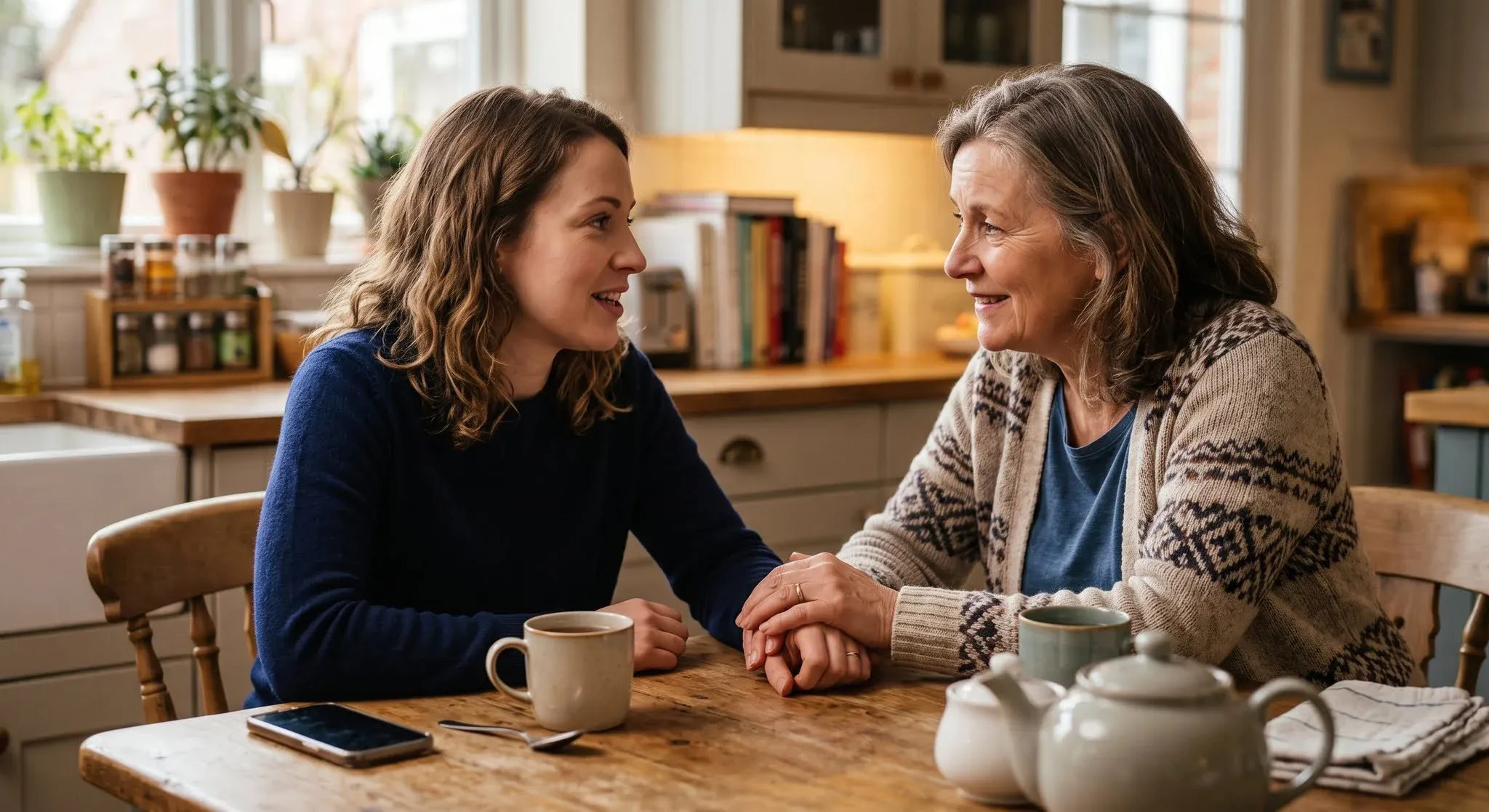
Enmeshment is a family pattern where the line between one person’s feelings and another’s stops being respected.
Your mood was their business. Their mood was your job. Privacy felt like betrayal, and wanting something different felt like leaving.
It is usually described as a family that is too close. The research says that description is wrong, and the correction changes how you untangle it.
What is enmeshment?
Enmeshment is the loss of a psychological boundary between family members, usually a parent and a child. One person’s thoughts, feelings and choices are treated as belonging to the other.
The term comes from the family therapist Salvador Minuchin, who set enmeshed families against disengaged ones in his 1974 book Families and Family Therapy. Enmeshed families had too little separation. Disengaged ones had too little connection.
Researchers now group it under a wider heading, parent-child boundary dissolution. That is the more precise name, and it is what you will find if you look for the studies.
What does enmeshment look like?
It rarely looks like harm from outside. It usually looks like devotion.
- Your feelings were managed for you: You were told what you felt, or told you could not possibly feel what you said you felt.
- Privacy was treated as suspicious: Closed doors, private messages and diaries were read as evidence you were hiding something.
- Their emotions set the weather: If a parent was anxious or low, the whole household reorganised around it, and you learned to track it.
- Independence was experienced as rejection: Moving away, choosing a different career or holding a different belief produced hurt, illness or silence.
- You were a confidant too early: You heard about their marriage, their money or their loneliness at an age when you could do nothing about any of it.
- Guilt did the enforcing: Nobody needed to forbid anything. Guilt tripping did it on their behalf.
Is enmeshment just a family that is too close?
No, and this is the most useful thing to understand about it.
A 1996 paper in Family Process argued that “enmeshment” had been lumping two different things together. One is closeness-caregiving: warmth, time together, nurturance and consistency. The other is intrusiveness: possessiveness, jealousy, separation anxiety, emotional reactivity and control.
A follow-up study of 264 couples tested the idea. The two dimensions separated cleanly. Blurring of boundaries loaded on different factors from warmth and nurturance.
| Closeness | Intrusiveness | |
|---|---|---|
| Time together | Chosen | Required |
| Your feelings | Welcomed | Overridden or absorbed |
| Your privacy | Respected | Treated as a threat |
| Your independence | Celebrated | Taken personally |
| After you say no | The relationship holds | The relationship punishes |
A family can be very close without being enmeshed. What made yours hard was never the amount of love. It was that the love came with conditions about separateness.
That matters for recovery. You do not have to become distant to get free of enmeshment. You have to become separate, which is a different thing.
What does enmeshment do to a child?
More than most people assume, and more than some of the patterns that get far more attention.
A 2024 meta-analysis in Psychological Bulletin reviewed 478 studies of parent-child boundary dissolution. It identified four patterns: enmeshment, chaotic disorganisation, the child acting as the parent’s caregiver, and the child acting as the enforcer.
All four were linked to children’s emotional and behavioural difficulties. Enmeshment had a stronger link to anxiety and depression than the child-as-caregiver pattern did, and stronger than the child-as-enforcer pattern.
A 2026 meta-analysis of 231 studies looked at intrusive parenting in young people aged 13 to 25. It found a modest but consistent association with anxiety and depression, and psychological control produced a stronger effect than helicopter parenting did.
Both are associations rather than proof of cause, and effects varied a great deal between studies. The direction, though, is consistent. Being denied a separate inner life is costly.
When the child also takes on adult jobs, that is parentification, and it often overlaps with enmeshment.
What is emotional incest?
Emotional incest, also called covert incest, is the popular name for a parent who makes a child into their emotional partner. It is not a clinical diagnosis, and it does not mean anything sexual happened.
The research version is more specific. A study that observed families when the child was two looked for an enmeshed pattern. One parent turned to the child for caregiving or intimacy, and shut the other parent out.
By age seven, after controlling for the mother’s depression, that pattern predicted depressive symptoms. Girls from those families more often showed depression, and boys more often showed symptoms of ADHD. The sample was mostly white and middle class, so it cannot speak for every family.
You may recognise the adult version. Being the one your mother called after every argument with your father. Being described as the man of the house at nine. Feeling that a partner of your own would be a betrayal of your parent.
If any contact was sexual, that is sexual abuse, not enmeshment, and it deserves proper support. Crisis support lists services that can help, including anonymous ones.
How do you know if you grew up enmeshed?
Mostly by what happens when you try to be separate now.
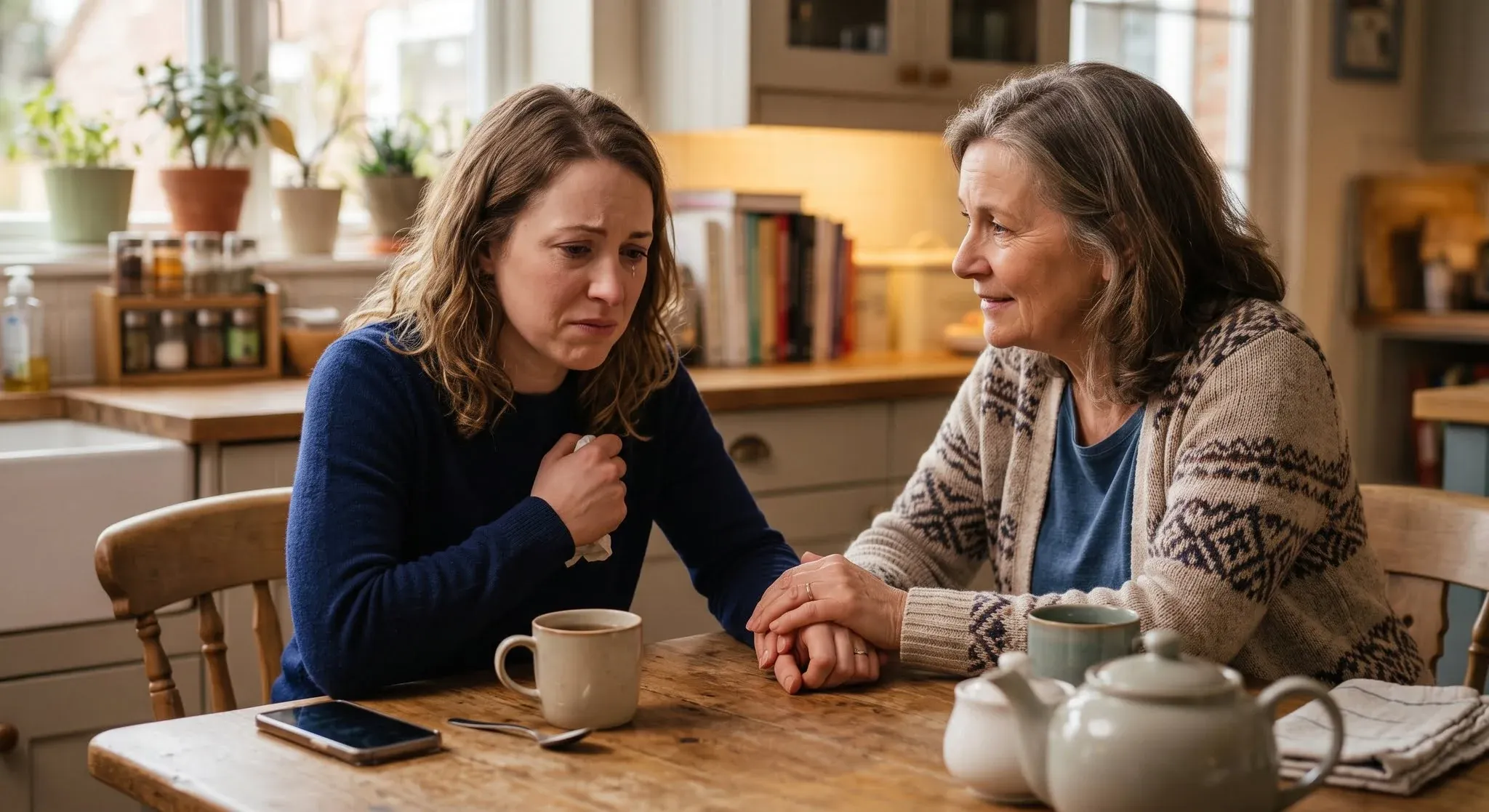
- Guilt arrives before any objection: You feel it the moment you decide something alone, before anyone has said a word.
- You check your decisions against their reaction: Often without noticing that you do it.
- Your own preferences are faint: You can describe what your parent likes in detail, and struggle with the same question about yourself.
- Their bad day ruins yours: A difficult phone call leaves you unsettled for hours or days.
- Partners feel like competition: Either you keep them at a distance, or you recreate the same fusion with them.
- Distance feels like cruelty: Even a reasonable gap between calls feels like something you are doing to them.
That list overlaps with self-abandonment and the fawn response. They are the adult habits an enmeshed childhood tends to install.
Is enmeshment abuse?
It can be, and it is not always.
Plenty of enmeshing parents are anxious rather than exploitative. They are frightened of loss, often repeating what was done to them, and they genuinely believe closeness is the same as love.
Others enmesh because the child is useful. A parent who needs admiration, a confidant or an ally uses the child to supply it. That is where enmeshment meets narcissism, and it is a familiar pattern in narcissistic families.
The test is not the parent’s intention. It is what happens when you become separate. Anxious parents struggle, then adjust. Exploitative ones escalate.
How does enmeshment connect to a narcissistic parent?
A narcissistic mother or father treats the child as an extension of themselves. Enmeshment is the mechanism that makes that possible.
Your achievements become theirs. Your failures become their humiliation. Your independence becomes their abandonment.
One sibling is often enmeshed while another is scapegoated, and the roles can swap. The family scapegoat covers the other side of that arrangement.
It can also come from a parent who is simply overwhelmed. Emotionally immature parents covers that pattern.
Is enmeshment the same as codependency?
They overlap, and they are not the same.
Enmeshment describes a relationship, usually one you were born into. Codependency describes a pattern in one person, usually in adult relationships: organising yourself around another person’s needs, problems or moods.
Enmeshment is one of the common roads into codependency. Growing up with your feelings treated as communal property is good training for treating a partner’s feelings as your responsibility.
How do you heal from enmeshment?
By building separateness, slowly, while the guilt protests. The family therapist Murray Bowen called this differentiation of self: staying connected to people without taking on their emotional state as your own.
- Start with small separations: A decision made without consulting anyone. A day before replying to a message. A preference stated and not defended.
- Treat guilt as a withdrawal symptom: It is the old rule firing, not evidence you are doing something wrong. It fades with repetition.
- Stop reporting on your life in full: You do not owe a parent an account of every decision. Share what you choose to share.
- Let their feelings be theirs: Someone can be disappointed by your choice without it being your job to fix the disappointment.
- Expect a reaction: Separateness in an enmeshed family often produces hurt, illness or recruitment of other relatives. That reaction is the system defending itself.
- Rebuild preferences from small things: Who am I after narcissistic abuse covers why identity returns through tiny choices rather than big insights.
Boundaries in an enmeshed family are experienced as attacks, even when they are gentle. That is not a sign you are doing them badly. Boundaries with a narcissist covers holding them where they will be resisted.
A therapist who works with family patterns can make this considerably faster. These patterns were learned, and learned patterns can change.
Can enmeshment happen in a romantic relationship?
Yes. The 264-couple study found the same split between intrusiveness and closeness among spouses.
In a relationship it shows up as a partner who needs to know where you are and reads your moods as verdicts on them. They resent your friends and treat time apart as rejection. That shades into coercive control when the intrusiveness is used to narrow your world.
Common questions
Can enmeshment be healthy? Closeness can be. Enmeshment, meaning the loss of a separate self, is not. The research suggests the harm comes from intrusiveness, not from warmth.
Can enmeshment cause BPD, OCD or PTSD? There is no good evidence that it causes a specific diagnosis. It is linked to higher anxiety and depression in general, which is different from causing any particular disorder.
Can enmeshment be one-sided? Often it is. One parent enmeshes while the other is distant, or one child is drawn in while siblings are kept out.
What does mother-son enmeshment look like? A son treated as a confidant or substitute partner, whose girlfriends are rivals and whose independence is mourned. The same pattern happens between fathers and daughters.
Can siblings be enmeshed? Yes, particularly where siblings raised each other or allied against a difficult parent. The same test applies: can each of you be separate without it costing the relationship?
Is it too late to change it as an adult? No. Differentiation is usually built in adulthood, because an enmeshed childhood did not allow it earlier.
What to take from this
Enmeshment is not a family that loved you too much. It is one that needed you not to be separate, and called that need love.
The closeness was never the problem. The conditions attached to it were. That means you can keep the warmth and still refuse the fusion, even if the people who taught you the rules cannot tell the difference yet.
Separate is not the same as distant. It is the only place real closeness can start from.
Where to go next. The narcissistic family system covers how the roles in these families lock together, and narcissistic parents covers the wider picture.
People pleasing covers the most common adult habit enmeshment leaves behind. Self-abandonment covers what that habit costs, and the fawn response covers it from the nervous system side.
If you want structured support with this, the 8 week narcissistic abuse recovery program works with exactly this kind of family pattern. If there is any question of danger, start with crisis support.
Coaching is not therapy and is not a substitute for medical or psychiatric care. If you are in crisis, please use the support resources on this site or contact your local emergency services.