Family Scapegoat: Signs and Recovery
The scapegoat role is folk language for something researchers do measure. What the evidence shows, why the golden child is not spared, and what helps.
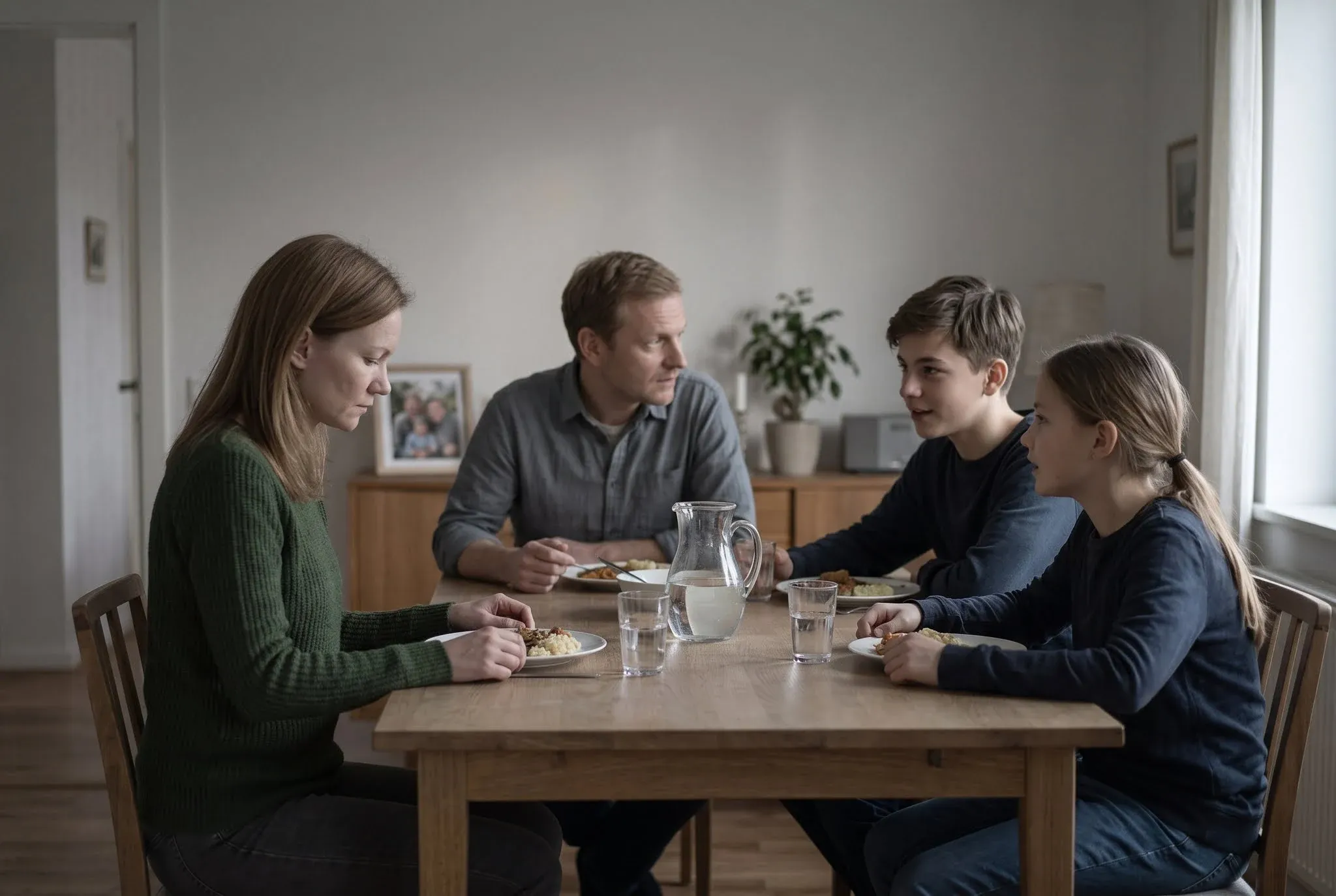
Something goes wrong and it becomes about you. It has been that way so long that you check whether it is your fault before you check what happened.
You are described as the difficult one, the sensitive one, the one who causes trouble. Your siblings get a different family.
The role is real and it has a name. What almost nobody tells you is that the name comes from clinical folklore, while the thing underneath it has actually been measured.
What is a family scapegoat?
One child carries the blame for a family’s problems. Conflict is routed to them, their objections become evidence of the trouble they cause, and the arrangement holds for years.
The vocabulary comes from family systems theory, where roles like scapegoat, golden child, lost child and mascot were used to describe how families distribute function.
Those terms are clinically useful and empirically thin. Search the research literature for family scapegoating and there is very little to find.
That is not a reason to doubt yourself. It is a reason to look at what researchers do measure, which turns out to describe your situation more precisely than the label does.
What does the research call it?
Parental differential treatment. How differently a parent treats one child compared with a sibling, measured rather than described.
That is the scapegoat’s actual claim. Not that your parents were harsh in the abstract, but that you got something your sibling did not.
A study of 148 late adolescents tested whether that comparison matters on its own, and the answer is the important part.
Perceptions of differential treatment predicted achievement and self-worth beyond what was predicted by the absolute levels of affection and control the young person reported.
Read that carefully. The difference between you and your sibling carried its own weight, over and above how warm or controlling your parents were in general.
So the comparison itself is doing damage. When you say it was not the shouting so much as watching your sister be spoken to differently, you are describing something with measured independent effects.
The study was cross-sectional, based on perceptions, and explained up to 13% of variance. That is a real effect, not a total explanation.
Which part of the difference hurts?
A 2024 meta-analysis of differential treatment pooled 13 samples and 215 effect sizes to separate two things that usually get bundled together.
Parents can differentiate by giving one child more warmth, or by giving one child more hostility. These are not the same, and they do not carry the same cost.
Differential hostility mattered more than differential warmth. Receiving more hostility than your sibling had a stronger association with behaviour problems than your sibling receiving more warmth than you.
The overall effect was small but significant, which is worth stating plainly rather than inflating.
That finding validates the scapegoat position specifically. The injury is not mainly that someone else was adored. It is that the hostility had a destination, and the destination was you.
Is the golden child fine?

No, and this is the finding that changes how people think about their siblings.
A study of 725 adult children across 309 families asked about perceived maternal favouritism and disfavouritism in midlife.
Depressive symptoms were higher in the children who saw themselves as their mother’s greatest disappointment. Expected, and it is the scapegoat’s experience confirmed.
Depressive symptoms were also higher in the children reporting the most closeness to their mother, and in those reporting the most conflict.
Being the favourite conferred no protection. The authors read the pattern as social comparison rather than fairness: being singled out costs, in either direction.
The association was stronger in Black than in White families, which the authors note and which is worth carrying rather than flattening.
Both roles were assigned. Neither was safe. That does not make your experiences identical, and it does mean your sibling is not the winner of a competition you lost.
What are the signs you were the scapegoat?

- Blame arrived before facts did. Whatever went wrong, the conversation started with you.
- Your role was fixed early. The difficult one, the sensitive one, decided before you could argue.
- Boundaries read as attacks. Saying no produced a response about your character rather than your answer.
- You were the family’s emotional weather system. Their moods were treated as things you caused.
- Accurate observations were punished. Noticing the problem out loud made you the problem.
- Siblings were positioned against you, which is how triangulation works inside a family.
- The story preceded you. Relatives already had a version of you before they had a conversation with you.
- Good news was inconvenient. Success complicated the role, so it was minimised or reframed.
The last one is the one people recognise last. If your achievements consistently produced tension rather than pleasure, that is the role protecting itself.
Why was I chosen?
There is no research answer here, and anyone confident about this is guessing.
What survivors describe recurs enough to be worth listing. Being the one who noticed. Resembling someone the parent resents. Being temperamentally less compliant. Arriving at a bad time.
None of these is a reason in any meaningful sense. They are features a family attached a role to.
The more useful reframe is structural. Families under strain sometimes locate the strain in a person, because a person can be blamed and a situation cannot.
That does not make the family evil and it does not make you complicit. It makes the role a solution to somebody else’s problem.
What does it do to you as an adult?
The mechanism sits inside a broader evidence base. A 2025 meta-analysis of 48 samples covering 27,150 young people found parental psychological control associated with internalizing symptoms at r = .27.
Longer term, a review of 23 longitudinal cohort studies found emotional abuse significantly associated with adult affective and psychotic disorders. Where multiple forms of maltreatment were present, the odds were more than three times higher.
What that looks like in practice is specific.

You audit yourself first. Conflict starts with an internal investigation into whether you caused it.
You over-explain. Requests come with justifications, because they used to need defending.
You expect to be disbelieved, so you either over-document or give up before you start.
Praise is uncomfortable. Being well thought of contradicts a long-standing arrangement.
You are drawn to fixable people. Being useful was the only stable position available, which is what self-abandonment becomes in adulthood.
Family gatherings reset it. You can be a competent adult everywhere and thirteen again in one afternoon.
Some scapegoats were also the family’s carer. Parentification covers that pattern and its effects.
How do you recover from it?
Stop trying to be exonerated. The role exists because it is useful to the family, so evidence does not dislodge it. This is the single most freeing thing to accept.
Give up on the group verdict. Individual relationships are sometimes salvageable. The family’s collective account of you is usually not.
Notice the pull to prove them wrong. Achievement aimed at people who will reframe it is exhausting and never lands.
Expect the role to be re-offered. Contact will come with an invitation back into it, and declining is a repeated act rather than a single announcement.
Separate your sibling from the role. They were assigned too, and the research says being favoured was not the prize it looked like.
Lower contact before deciding on none. Shorter visits, less disclosure, an exit time. Where the role reasserts itself in any dose, no contact is what remains, and boundaries covers the enforceable version.
Get one person outside the system who knows the whole story. Being described accurately by somebody undoes a surprising amount.
Common questions
Is family scapegoating a recognised condition? No. It is descriptive language from family systems theory. What is measured is parental differential treatment, and the effects of that are documented.
Can the scapegoat and golden child roles swap? Yes. Roles are assigned by the family’s needs, and those change, particularly when a scapegoat leaves.
Why do my siblings deny it happened? Because their childhood genuinely differed, and because acknowledging it would require re-examining their own position.
Is the scapegoat the healthiest one in the family? A popular claim with no evidence behind it. Scapegoats do often leave first, which is not the same as being unharmed.
Should I confront my family about it? Rarely productive as a group. It typically confirms the role rather than ending it.
Will they ever admit it? Plan on no. Recovery that depends on their acknowledgement hands them a veto over it.
What to take from this
The label is folk vocabulary. The experience underneath it is measurable, and the measurements support what you have been saying.
Difference itself carries weight, beyond how warm or harsh your parents were overall. And of the two ways to differentiate, hostility toward one child does more damage than warmth toward another.
Your sibling was not spared. Favoured children show elevated depressive symptoms too, which is worth knowing before you spend years resenting the wrong person.
You were not chosen because of something true about you. You were chosen because the role needed filling.
Where to go next. Narcissistic parents covers the wider picture and the narcissistic mother covers the most commonly described version of it.
Narcissistic triangulation covers how siblings get set against each other, and what abuse does to your body covers the long-term physical cost.
Inner child work covers how to revise the rules a scapegoated childhood installs, without the parts of the method that can backfire.
If you want structured support with the self-blame specifically, the 8 week narcissistic abuse recovery program is built for it. If there is any question of danger, start with crisis support.
Coaching is not therapy and is not a substitute for medical or psychiatric care. If you are in crisis, please use the support resources on this site or contact your local emergency services.