Narcissistic Abuse and Your Nervous System
Three things make this kind of abuse specifically hard on the threat system: unpredictability, suppressed defence, and losing co-regulation to the threat.
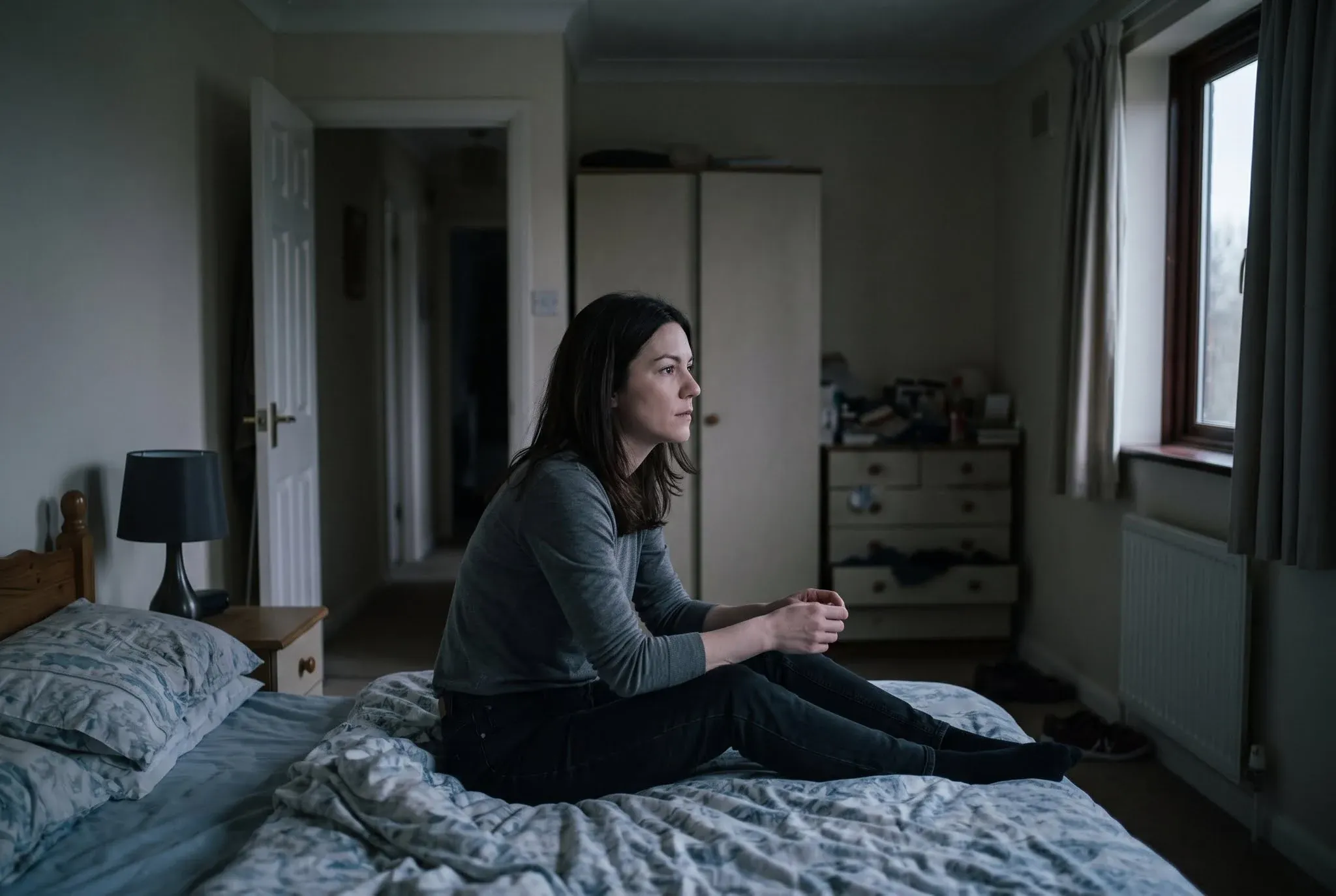
Your body kept doing things your mind had already stopped agreeing with. You flinched at a text tone. You rehearsed conversations at 3am. You read a room before you read a person.
That is not anxiety arriving from nowhere. It is a threat system that was trained, accurately, by conditions that no longer exist.
This page is about the training. Not nervous system regulation in general, which is covered separately, but what this particular kind of abuse does and why it is unusually effective at it.
What does narcissistic abuse do to the nervous system?
Three things, and it is the combination that matters rather than any one of them.
Plenty of hard experiences are stressful. What makes this pattern specifically corrosive is that all three run at once, for years, inside a relationship you cannot easily leave.
1. The threat is unpredictable
This is the active ingredient, and it is worth understanding why.
A predictable threat can be prepared for. If something bad happens every Thursday, your system learns Thursday. The rest of the week is yours.
Intermittent and unpredictable threat produces no such schedule. Warmth on Monday, contempt on Tuesday, and nothing you did explains the difference. The only viable strategy is continuous readiness.
That is the same intermittency that builds the trauma bond. It is doing two jobs at once: attaching you, and keeping your alarm permanently armed.
2. Your defences were suppressed, not used
Fighting back got punished. Leaving the room got followed. Explaining got turned around on you.
So the two responses your body is built for, fight and flight, were both taken off the table. What remains is a defence that costs you.
The defense cascade describes the sequence properly: arousal, then fight or flight, then freezing, then tonic immobility, then collapse. These are not personality settings. They are stages the body moves through as escape becomes less available.
When escape is blocked and the threat is a person you live with, the system settles into the later stages. That is where appeasement comes from, and researchers have described exactly this as traumatic entrapment, where appeasement behaviours become the organising defence and complex post-traumatic symptoms follow.
The everyday name for it is the fawn response.
3. The person who should have been safety was the threat
This is the one nobody outside it understands, and it is the most damaging of the three.
Human threat systems are designed to be calmed by other people. Someone steady in the room lowers your arousal without either of you doing anything deliberate.
In this relationship, the person nearest to you was the source of the danger. So the mechanism that would normally bring you back down was the mechanism producing the alarm.
That is why isolation compounds it so badly. Cutting you off from friends and family does not just remove practical support. It removes the last remaining regulators.
Which part of the nervous system does this affect?
The autonomic nervous system, which is the part that runs without you deciding anything. Heart rate, digestion, breathing, pupil size, sweat.
It has two branches, and the popular version of this gets them slightly wrong.
The sympathetic branch mobilises. It is the accelerator. Heart rate up, muscles primed, digestion parked, attention narrowed onto the threat. This is what people mean by fight or flight, and it is what stays switched on after years of unpredictable danger.
The parasympathetic branch is usually described as the brake, and that is the part worth correcting. It is not simply an off switch. One of its actions produces the collapse end of the defence sequence, the heavy, flat, cannot-move state, which is the opposite of calm.
So “activating your parasympathetic nervous system” is not automatically a good thing to aim at. Both branches can produce a state you do not want.
A more useful way to think about it. Your autonomic nervous system is not on a single dial from stressed to relaxed. It produces distinct states, each of which was appropriate to some situation, and the aim is flexibility rather than permanently low arousal.
What sustained sympathetic activation feels like
Chronic sympathetic activation after abuse is unglamorous and easy to mistake for personality.
- Sleep that will not start, or waking at the same time every night.
- A resting state that is never quite at rest. Jaw, shoulders, stomach.
- Digestive trouble with no clear cause, because digestion is what gets parked.
- Startling at ordinary noise. A door, a phone, a raised voice on television.
- Difficulty concentrating, because attention is committed elsewhere.
- Irritability that arrives faster than the thought.
None of these are proof of anything on their own. Together, after the relationship this page describes, they are the expected picture.
Why do I still feel anxious after leaving?
Because the system has no way of knowing the situation ended.
Threat learning is fast and deliberately hard to unlearn. That asymmetry keeps animals alive. It also means that safety has to be demonstrated repeatedly over a long period before the alarm stands down.
The timescale is longer than most people are told. A study that followed 309 women across four years after separating from an abusive partner found health improving significantly, with meaningful post-traumatic symptoms still present at the end.
So the honest answer is that the anxiety after leaving is not a relapse and it is not evidence that leaving was wrong. It is the expected shape of the recovery curve.
What is chronic activation actually doing to your body?
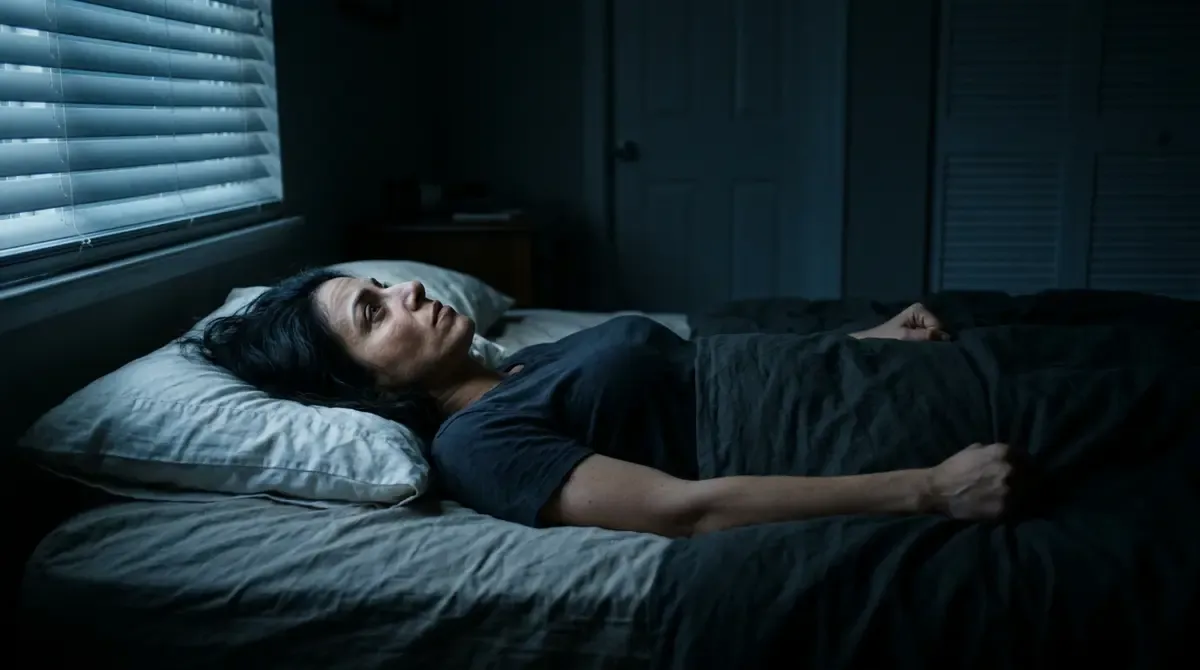
Two measurable things, and both are more modest than the internet claims.
Stress hormones. Sustained stress alters cortisol patterns, and researchers use the idea of allostatic load for the cumulative cost of a system held in adaptation for too long.
One honest caveat that page also makes clear: there is no ordinary clinical test for this. A single cortisol reading tells you very little, and anyone selling you a test that diagnoses your dysregulation is overselling it.
Heart rate variability. Lower variability is associated with anxiety disorders, established across 36 studies comparing 2,086 patients with 2,294 controls. It is a real signal, and it is a group-level finding rather than a personal diagnostic.
For the longer-term health picture, including inflammation and disease risk, what abuse does to your body covers the larger evidence base.
Which state am I in right now?
Naming the state is genuinely useful, because the response that helps differs by state.
Running hot. Racing thoughts, tight chest, scanning, irritability, unable to settle, sleep that will not come. The system is mobilised with nowhere to put it.
Gone flat. Heavy limbs, blank mind, cannot start anything, watching yourself from outside, sleeping far too much. This is the shutdown end of the cascade, and dorsal vagal shutdown covers it in full.
Appeasing. Automatically agreeable, monitoring the other person’s mood, apologising before you have worked out whether you did anything. This is the fawn pattern.
Settled. Present, able to think and feel at the same time, other people register as company rather than as weather.
Most people move between the first three during a bad week, which is normal and not a sign of getting worse.
A correction worth knowing about
Most articles on this subject, including the earlier version of this one on my old site, explain all of it using polyvagal theory.
That theory is no longer safe to present as settled. In February 2026, thirty-nine specialists in vagal physiology and vertebrate evolution were invited to evaluate polyvagal theory. All but one accepted, several had been cited in the polyvagal literature as supporting it, and they concluded it is untenable.
The descriptions of the states are still useful. The evolutionary mechanism underneath them is not established, and the defense cascade is the better-evidenced model. It also distinguishes freezing from tonic immobility, which the popular version runs together.
I am flagging this because you will meet the polyvagal framing everywhere in this niche, usually stated as fact.
What actually helps?
The thing with the strongest evidence is also the least impressive-looking.
Slow breathing. A meta-analysis covering 223 studies supports slow-paced breathing as a way of shifting heart rate variability, and a systematic review sets out the mechanisms. Longer out-breath than in-breath. Roughly six breaths a minute.
Other people, once they are safe ones. Since the loss of co-regulation was mechanism three, restoring it is not optional extra comfort. It is the direct repair.
Ending the input. No regulation practice competes with ongoing exposure. This is the physiological argument for no contact, and it is why contact strategy comes before technique.
Time, with the situation actually over. Slower than anyone wants, and it does move.
What I would be careful with is anything sold as releasing stored trauma in a session, and any device or protocol promising to reset your vagus nerve. Those claims run far ahead of what has been tested.
Common questions
Is nervous system dysregulation a diagnosis? No. It is a description, not a clinical category, and no test confirms it. That does not make the experience unreal, and it does mean nobody can diagnose you with it.
Why did I not fight back or leave? Because your body ran a defence that suited the situation you were actually in. When fighting is punished and leaving is followed, freezing and appeasing are what remains. That is a physiological sequence, not a decision you failed to make.
How long until my nervous system settles? Longer than six weeks and shorter than forever. The four-year data shows steady improvement rather than a finish line, and the strongest lever you control is whether the contact has genuinely stopped.
Can this happen from a parent rather than a partner? Yes, and it tends to be more deeply installed, because the training happened while the system was still forming.
Do I need therapy for this? Not necessarily, and it helps. If you have symptoms that meet a clinical threshold, particularly losing time or persistent dissociation, that needs a clinician rather than a breathing exercise.
What to take from this
Your nervous system did not malfunction. It learned exactly what it was taught, by conditions built to teach it.
Unpredictable threat kept it armed. Blocked defences pushed it into freeze and appeasement. Losing co-regulation removed the only thing that would have brought it back down.
None of those three are character flaws, and all three reverse in the same order they were installed. Stop the input, restore safe company, and give it considerably longer than you have been told to expect.
Coaching is not therapy and is not a substitute for medical or psychiatric care. If you are in crisis, please use the support resources on this site or contact your local emergency services.